Showing posts with label Clayton Cheever. Show all posts

Thursday, May 7, 2009

Black belt librarians: dealing with challenging patrons


More pictures are on flickr.

2-3:15 PM, Meeting Room 2, Thursday, 5/7

Warren Graham is a security professional who works with "the reality impaired".

"How to walk up to a perfect stranger and tell them to knock it off while protecting your safety" is the main topic today.

His background is in the library in Charlotte, NC. The old building, which closed in the 90s, had all sorts of security problems, including childhood assault in the bathroom. Private security firms failed so the director hired Warren.

"If you do not deny access to people who are destroying the library you are denying patrons to your regular patrons.... Just because its a public library doesn't give you license to build a fire in the middle of the floor.... Don't let the inmates run the assylum, you have a right to a safe workplace.... You deserve to be treated as the professional you are. Its not right not to feel empowered not to tolerate abuse.... It's way past time in the library world to start making patrons more responsible for their behavior."

Solid and simple is better than over-intellectualized meetings full of pontifications that go nowhere. Thick security manuals that say nothing are useless. They should be lean and simple.

Everyone has to be trained properly.

Rules have to be enforced consistently by everyone.

Everyone has to be treated the same. The same consequences have to apply to everyone.

3 things that make a security program effective:

1. Must have simple, strait forward rules for library use.

Examples of stupid rules "no prostitution", "Causing intentional alarm by indecent exposure".

One rule every library should have: Any behavior that is disruptive to library use it not allowed. This rule can replace TONS of other rules.

Problem patrons are only 1-2% of library patrons but most of these hard line behavior problems only understand a hard line.

Administration has to back up staff. There are always exceptions but that should be rare.

2. Consistency is critical - between staff, branches, everywhere.

3. Always apply rules based upon BEHAVIOR not APPEARANCE.

Be careful with loose talk around the library. People listen and observe all the time. "These street people... these banking yuppies from hell.... these Satan's spawn... that little monkey on acid - one more time and that kid's out" DON'T SAY THESE THINGS!

How to tell someone NO:

1. Approach with a confident frame of mind.

Most people comply if you approach them correctly. Its not about confrontation its about communication. Its not policing, its advising patrons as to what's not allowed in the library. Relax when you go up to a patron. Too tense and you'll over-react. Give them the benefit of the doubt.

2. Start nice and you can get tougher if you have to. You can't come on too strong and then ease off.

Whenever approach someone for the first time, usually for something minor start "I don't you didn't see the sign, but............." or "I know you didn't know, but.....". This gives the patrons an out so they don't feel like an absolute idiot. Make sure they know you're giving them the benefit of the doubt.

Stop saying sorry. Just say "I know you didn't know". Apologizing opens the topic up to conversation and conflict.

Do not be a helicopter librarian. Tell them, thank them, then move on. Check back in a few minutes to make sure things are ok. Don't just stand there and hover.

3. When you approach people, exercise prudent caution.

Blend this together with confidence. Confidently cautious and cautiously confident. Whenever telling someone NO, keep any barrier you can between you and that patron. Don't even give up chairs, floor plants, desks, book carts, any barrier is good.

Don't forget about personal space. A stressed out, upset, or disturbed person is even more sensitive about personal space. Close enough to touch is too close. Never touch anyone except in self-defense.

If someone is sleeping and you need to check on them, go up, stay on the other side of the table ad ask if the patron is ok - express concern for their health. Don't assume they are hearing impaired just because they are asleep. You don't want to startle them and give them cause to explode. If they are still asleep, lightly tap the table - but be gentle, with a head on a table it will be amplified. If you still can't wake someone up, call 911.

WHENEVER you tell someone no, do not immediately turn your back. No matter how nice they have been, you don't want to put yourself in that vulnerable of a position. Appearances mean NOTHING when it comes to trouble. Be slick about walking away - look at your watch as you walk away to keep them in the corner of their eye, turn around and scan the room as if looking towards something else, be discrete and don't come off as obviously watching them, but don't let them out of your sight until you're safely away.

4. It doesn't matter if you're telling someone no or not, whenever you discover drunk or otherwise chemically incapacitated, they need to go. Smelling booze is not the same, its when they are obviously drunk or high that its time to call 911 and for that person to go.

Regardless of outside conditions, other patrons don't want incapacitated patrons around. No one is harmless when under the influence.

5. Everyone has to tell someone NO sooner or later. Someone is going to take exception. The experienced behavior problem knows that if they can upset you they can control you. Don't let them break your mental rhythm.

Tell someone no and only three things can happen:
a. they comply
b. they leave
c. they say no they won't comply and won't leave - and you have a plan for how to deal with this as well.

6. Never argue with a patron.

A lot of people are very good at pointless arguments. Don't engage. If they keep on trying to wear you down they are being disruptive and need to leave.

Sooner or later you will be accused of some sort of bias. Everyone can come in, but everyone has to follow the same rules. The person you're saying no to could be a victim of past bias. Most of the time, they just want to throw you off. Just treat everyone the same and stay on topic. Don't respond to accusations of bias.

Teen areas are GREAT. When you want to be a destination of choice for youth, remember:
most kids are good kids
most problems with kids are caused by STAFF fears, problems, and dislikes
even big kids are still kids with kid fears and insecurities. They don't want to let people know they are afraid and say silly things to hide this.

Actively manage the room - acknowledge teens, make sure they're doing ok. Be casual and relaxed. Some kids need extra warnings but all the same, disruptive behavior is not acceptable from anyone and adults have a right to use the library as well.

7. Never go outside with a behavior problem.

The front door is the limit. Once outside people feel emboldened to do things they wouldn't consider inside. Standing just outside the doorway is ok if you need to get a license plate number for example, but stay in the doorway. Stay cool and stand guard over yourself. Do not chase thieves out of the library.

8. Before you go and correct someone's behavior, make sure you have the right person.

There's an ocean of difference between suspicion and guilt. You have to be aware of something happening. Then just keep communicating with people in house, share suspicions, be PATIENT and sooner rather than later you'll figure out what's going on.

The single most important thing to take from this session:

Awareness is the best security tool. Ultimately your safety is in your own hands.

Practice 30/30/30. For the next 30 days stop every 30 minutes and look around for 30 seconds. This will heighten your intuition and help raise your guard.

No matter how small your community, if there's one village idiot, he WILL come to your library. Be prepared. Have a plan. Your security plan is just as important as your circulation procedures.

Warren's website: www.blackbeltlibrarians.com

Q&A:

When the alarm goes off on the security system, you must respond every time. Refine your guidelines so you know how to react when you catch someone. Theft of library materials is a serious matter. Treat it as such. Say: "When the alarm goes off I just need to check. Its probably our fault and we didn't deactivate something."

When the kids go outside they all stand in the foyer and block traffic into the library. Just open the front door and go out a few feet. Its best to go with someone or have someone watch you even then.

HELP! I'm so STRESSED!

11:30-12:45; Meeting Room 4

This session started with everyone filling out a self-assessment of their personal stress level that was designed to measure personal vulnerability to stress.

Stress is a function of events, attitude, and behavior. We can most control attitude. There are many physical reaction we experience when under stress. Its very hard for our bodies to manage all these experiences. There are also emotion and cognitive effects. Recognizing the effects stress have on you is a good way to clue into the need for stress management. Standard stressors include: work., family/relationships, finances, changing schedules, illness, substance abuse, care taking others, need to be "perfect", and loneliness. Its ok to be good enough. Defining what good enough means can help a lot to reduce unrealistic expectations. The audience also contributed the following as stressors: school, loss of significant people in your life, moving, seasons (winter), work transitions, media / news (turn it off!), keeping up with technology (and just keeping up in general), housework (laundry, home maintenance, etc.), daily little things (catching a train, keeping track of your keys...), noise, technology failures, and guilt ("one of the more useless emotions there is, throw it all out!").

What gets in the way of stress management? Never enough time, caring for others, isolation, poor diet, too little exercise, keeping score (why aren't they doing their share while I'm doing so much?), loss of perspective (you have to continually prioritize), drinking too much, too little sleep. The audience contributed: ever increasing work loads, shrinking work forces / layoffs, and feeling constantly overloaded to the point of inertia setting in (give yourself permission to ignore stress), and feeling that we have to be connected electronically 24/7,

A useful tool - do only one thing at a time - when eating, just eat, don't do anything else. Meditation also works for several people. Taking a FIVE minute break can be very helpful. Its very short and can make a great difference.

Laura doesn't have internet at home and has "trained" all her friends to call her if they need her outside work hours.

Its important to establish a personal support network. Potential sources include: family, friends, community, work network, and professional help. An audience member expressed discomfort with co-workers sharing too much personal information. Laura addressed this with the need to establish limits and acknowledged that this can be a tricky environment. Another audience member talked about the role spiritual and religious groups can play as part of a support network.

Skills to cope:
Logistics: planning, organizing, communicating, setting limits, delegating, establishing support.
Physical: breathing, stretching, visualization, meditation, progressive relaxation.
Other important skills include: establishing time limits for activities and conversations, redirecting conversations to clarify what role you are filling, managing interruptions ("give me five minutes" be or "lets schedule a time to discuss this"), using visual displays to indicate availability (green/red door hangers for free/busy so can close door and indicate ability to be interrupted or not), setting specific agendas, and holding regular meetings to conduct specific types of conversations that don't need to happen immediately.

"You have a right to set a limit to what you are doing."

An instant piece of control can be obtained through some physical tools. Daily meditation allows the brain to have a chance to detox and changes Laura's ability to manage stress. Just breathing and slowing down your heart rate is powerful. Daily meditation develops the ability to instantly enter a meditative state.

The audience was led through a progressive relaxation exercise. They sat straight, put feet flat on the floor, closed their eyes, and relaxed with heavy hands. Laura talked people through thinking about their body, starting with the top of the head, through the temples, the eyes, paying attention to breathing, relaxing the brow, going down to the cheeks, lips, nose, and this relaxes your entire head. Laura continued to talk the audience through relaxing their shoulders, back, and on down through their feet to the floor. This went on for approximately 5 minutes. It ended with each person being encouraged to take three breathes and open their eyes. She described this as a "body scan" and encouraged everyone to do this at any time they felt stress.

MassCat's move to open source software: An update


9:30-10:45 AM, Thursday, May 7, Meeting Room 5
More pictures available on flickr.

Nora Blake's Powerpoint presentation will be posted later.

MassCat has around 90 libraries, mostly schools, that pool resources and are ot a part of the other library networks in the state.

It started live full force with Koha in the fall of 2008 with over 1,200,000 holdings. They signed with LibLime to partner in the migration. They had to break down the existing catalog into individual files for each member library. To distinguish each library they had to add prefixes onto each barcode. Because they didn't want every library to have to replace their barcodes the searching by barcode requires filters and/or keyword searching.

The catalog started with over 625,000 records, but many were duplicates and it was not as clean as they would have liked because of how things had to be broken down by library.

Why Open Source? They had a direct influence on the development of the software and benefited from the work lots of other people are also doing to develop it.

They chose Koha after looking at Evergreen. Koha's OPAC was more attractive, had an integrated serials management system, a clean staff interface, was entirely web-based (no software downloads for clients). Looking forward to a 3.2 release this summer.

Link to OPAC: masscat.kohalibrary.com

Currently, can't search a group within a group. To scope a search to a specific library's collection, each library has a unique URL from which they can broaden they search. They working on developing more sophisticated searches defined by geographical areas - likely to be a drop down search option.

Nora would prefer a larger font in the OPAC, but this is fairly easily changed by browser customization. Book jacket covers come for free - using Amazon. The downside is it just searches by ISBN and grabs the first result. Sometimes this returns no image.

The main page has a "lists" tab and the public lists display all the public lists, they currently can't be limited to just one library's. Patrons can create private lists. (Lists are for bibliographies).

Students are using the comments attached to books. To create a comment you have to login and they're reviewed by library staff before they are posted.

For holds, the pickup location can be changed from the location of the owning library, but in this network this is not often done. Notification of when holds are available for pickup is an opt-in email notification system. This can also be controlled from the staff side. Libraries can also create event notifications and use the same email system to send these out. With the addition of another company, text messaging can also be added into this system. Masscat is looking into doing this next year.

The staff interface has a news section on the home page which is used for communication with the participating libraries. A current problem: management of holds that can not be filled is not really working - if a library can't fill a hold they mark it as such, but it just sits in their hold queue. There are work-arounds that libraries are using, but an integrated solution is hopefully in development.

Under Circulation reports there are two holds links: a queue and "to pull". The "to pull" is not what it sounds like and will hopefully go away with the next release.

You can load images for patrons to associate with their account, individually or in a batch.

In the 3.2 release they are working on audible clues, especially helpful when on the front line for flags - such as fines, notes, etc.

A big shift: the system automatically emails overdue notices. If no email address is associated with a patron's account an email is sent to the library's email address. This presents some logistical issues in the schools and has required that they change their workflows a bit.

A tool that MassCat created was a shortcut to a z39.50 search. This search was available before but buried. This is in addition to the three primary types of searching: basic, advanced, and catalog. When you execute a z39.50 search you get a pop up window that lets you refine your search and check off the libraries whose collection you want to search. Member libraries have discontinued their OCLC accounts as a cost savings, but Nora still has one and can use it to look beyond the libraries in the list. Once an acceptable record is found via a z39.50 search its just one click to import the MARC record.

They've found that Koha has a lot of development still to do and a lot of what they expected wasn't actually there, at least not in a usable form. It works, but there are areas, especially around holds, that still need a lot of work. Its complicated because a lot of libraries are using it as a Union catalog and aren't actually using it as a live system - so it can't display real time status for their items.

They had expected a faster new release cycle than what is typically provided from proprietary vendors, but so far, this hasn't been the case. However, bug fixes and improvements are made "fairly frequently". Another big difference is that since its open source, the faults are much more widely known - there's nothing to be gained by hiding them.

The Koha community elects a "release management". The entire process for how improvements are agreed upon to include in a release isn't clear. Its done in committee meetings and Nora is confident that the improvements that she's made will be included in the next release. LibLime is the tech support that MassCat has contracted with. Some local public libraries have tried using Koha alone. It would require a lot more staff and time to do it without LibLime. Nora said she would need to hire at least one more staff person with a more technical skill set were they to consider going it alone.

There a lot of supporting email lists and web sites that are in the powerpoint presentation which will be linked to once its online.

They did not find training material that would work for their needs, so they created their own.

The virtual catalog is in development and MassCat is waiting to see how this develops to find out how they can work together.

Reporting: there's a lot of "out of the box" reports in addition to the ability to create customized sql reports. On the Koha wiki community members are sharing their sql reports so others can benefit.

In summary: its much better than what was before. The transition wasn't easy and "not the BEST thing we've ever done" but Nora's happy with it and believes most of the contributing libraries are as well and they're certainly sticking with it.

Wednesday, May 6, 2009

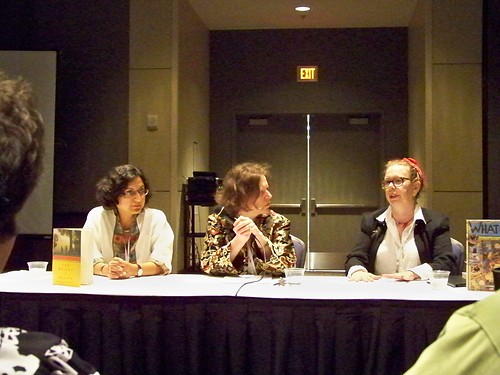
Author Panel II: Different Ways to tell stories


More pictures on flickr

Storytelling - its everywhere!

Lynda Barry has a new book "What it is". Its based upon an idea she got in a college painting class" image is different than thinking. Think of your first phone number. Now think of one from three numbers ago. It feels different and good to remember the first one. When you get a really good book, you slow down before the end, when its over, you stop and look at it - you don't just put it down. Then the book contains an image for you. Images are all about mental health. She's really interested in images, stories, how people deal with objects - that's what her new book is about. "Librarians saved my life. Thank you, thank you, thank you!! I've seen the way you quietly slip a book to someone, I've seen your actions."

Thrity Umrigar switched from journalism to teaching 13 years ago. Her new book "The weight of heaven: selected memories of an Indian childhood" tells the story of an American couple in their 30s who've just lost their 7 year old son. They're from Ann Arbor and have been living outside Bombay for about 16 months when it opens. 4 months after their son's death the husband is asked to open a new branch in India and off they go. "India turns out to be nobodies wallpaper". The wife thinks a change of local will help them heal and salvage their marriage but finds a country that asserts itself into their lives in two ways. The husband is drawn to their housekeeper's 9 year old son and becomes obsessed. The American company he works for, Herbal Solutions, has just purchased significant acerage in India for cultivating a tree that treats diabetes. The local people are not happy with the exporting of this resource and how its being owned. The message is all about how things we haven't dealt with come back to us later.

Lynda wrote her first novel in 10 days. The next she took 10 years to write "because the computer had a delete button". Then she started writing books by making books from construction paper, and then she progressed to a paint brush - and that took nine months. When combining pictures and words, she thinks there's a completely different story that's told with our hands than when we use electronic means. Thats why she really likes to mix them. Images are not decoration, they serve an absolute biological function. If you can't draw, go home and create a hand print turkey - try it, you'll feel better!

Jump from journalism to fiction? Why?
Fiction can tell you the truth. Journalism gives you the facts, or really, opinion any more. Thrity didn't grow up with artists around her but knew since age 5 that she always wanted to be a writer and "took a shortcut" by becoming a journalist. She realized people always considered journalism a poor cousin of literature so she tried to create journalism that read like literature. In that sense, it wasn't a huge leap into writing fiction. She was happy to help other people tell stories but got to a point where she wanted to tell her own stories. She really likes telling emotional, psychological truths about how we function in the world. The need to tell stories is what makes us human. Even when you're telling the truth you're writing fiction. Even memoirs are acts of creation, creating your own persona.

Lynda once had a friend with a real imaginary friend (hers was an imaginary imaginary friend) She new it was real because it had a dumb name - Sprinkles, and she could only talk to it through a fan (sorry you missed the demonstration). She also gets lost reading cereal boxes.

Thrity entered a sad alternate reality while writing this book. There was something about this subject matter, the frequency that couple's loose children, and its possible someone in this situaiotn could pick up her book so she felt a great responsibility. Her greatest concern: the book had to be emotionally honest. Its a weird subjectivity / objectivity that she enters when she writes things close to her own experiences. She hates stories of happy childhoods, because childhood, for everyone, is hard. How did she know what the grief would be like? She just thought about it and was able to feel it.

Lynda's faux naive style isn't faux. Its really hard for her and she's tried everything else she can think of, but how she creates is just her - and "it takes a lot of nerve".

The wife (Ellie) in Thirty's book makes two good choices. She's "made large" by what's happened and becomes much more sensitive to the world around her. The husband (Frank) has the opposite reaction and closes down, becoming a very bitter person. Ellie embraces India and Frank tries to force American values onto it - and fails badly. We all start life with a vision of what we want to be when we grow up, what the world should look like. Thrity wanted a life filled with music, fresh flowers, good friends. She feels incredibly lucky. For all the difficulties in her childhood she's also had a lot of love, especially from her extended family - aunts & uncles.

Lynd knew in third grade all about pioneers - esp. Lewis & Clark and she wanted to be one. Once you decide what an image is, the form you give it is up to you. She's clearly become a metaphorical pioneer. She got a good break because someone mis-interpreted her strip and yelled at her, and then someone else who hated the yeller started printing her strip on the back page just to spite the editor.

Thrity doesn't speak for the huge, complicated, complex country of India - and no one person ever could. She doesn't tell stories about India, but does include parts of India in her novels.

Mashups: Graphic novel is a term not liked by any cartoonists that Lynda likes. However, its necessary so they can be sold. Comics, alternative comics, punk comics, hippie punk comics, no graphic novels - and not Lady Chatterlies Lover - a true GRAPHIC novel. On Amazon her book is classified as science fiction! She edited a collection of "best of" graphic novels and was amazed at all the rules - after they were applied it was just depressed guys with headaches writing about their sex lives. She LOVES the reluctant reader award - thats who she wants to reach.

If Thrity wrote a graphic novel she doesn't know what it would look like.

The floor asked Lynda for her influences: Dr. Seuss. She wanted to be what he was. She didn't know what he was, he's classified as a graphic novelist - a faux naive artist. She liked R. Crumb - terrified by his stories which she found when she was 12.

Thrity was influenced by Salman Rushdie - loves the ambition and audacity of his writing. She didn't read a single Indian writer until just before leaving India for the US at age 20. Her first was Midnight's Children. She also was influenced by Toni Morrison and Virginia Woolf - dazzling language and amazing grasp of human psychology.

Lynda: All a writer does is hold images a little longer than the rest of us, capturing places & moments, what's around us, to the right & the left.

Lynda's favorite thing to do is teach. She does it very DIY - tickets on ebay, do workshops anywhere - Bars, yoga studios.... She was just at Manitowoc high school teaching and really got excited by the girls there who are really into Manga. They have a graphic novel collection at their library and loves how libraries are opening this portal for girls. In her class, if a cellphone goes off the owner has to buy her a shot of whiskey.

Thrity teaches creative writing courses and her students are often taking their only writing course. She sees her primary role as all about teaching PASSION. She likes to play the "holy fool" - she teaches touching, feeling, sentimental existence.

Thrity finds the future of journalism very frightening. It's insane to consider a democracy without newspapers - who else will hold the politicians accountable? She subscribes to the NYTimes as an act of charity - she reads it online everyday and sees buying newspapers as a moral issue that we need to push.

Lynda's most reliable source of income is selling stuff on ebay. She used to be carried in "alternative" papers across the country but now that job is gone. The loss of physical papers is a real loss.

People always think Lynda's books are for kids - but they have really mature subject matter. She doesn't think they are a good thing to give to kids / teens. If they find it on their own that's another thing altogether.

Fee copies to be signed by the authors were provided at the end.

Pictures will be added to this post later today.