Showing posts with label radical reference. Show all posts
Showing posts with label radical reference. Show all posts
Tuesday, May 8, 2007
MLA Speaker in Sunday's Boston Globe
In a neat bit of serendipity, Jenna Freedman, librarian at Barnard College, and recent MLA speaker on Radical Reference, was interviewed for a piece in the Sunday Boston Globe entitled "File under other." The article discusses 'zines in libraries, the challenges and the benefits.

Friday, May 4, 2007
Radical Reference - Jenna Freedman & Eric Goldhagen

Summary & My Thoughts: This session was an introduction to the Radical Reference Service http://radicalreference.info/ and the technology it uses to operate it’s online presence. I love the idea of this service and their efforts to not only operate a website but get out in the street and into communities to support activists and information seekers. While attempting to support activists they seek to create an authoritative site that librarians and information seekers will trust & utilize. It seems to coincide with the social software and increasing communication movement that is a major online trend. RSS Feeds/Email updates, Wikis, and other aspects of 2.0 have been included in their website to offer a high level of communication and interaction with site users.
They use open source software as a technological basis; Eric advocated for libraries and others to use these tools to increase collaboration, free access, etc… while also offering tips and ideas for getting started and using these resources successfully. He displayed links to lots of useful information on this topic and a slide that demonstrated open source tools that may replace different types of proprietary software that I found particularly helpful.
Tools Mentioned: Open Office, Drupal, Ubuntu, and more, check out the presentation link online at http://radicalreference.info/jenna/masslibassn
Tools Mentioned: Open Office, Drupal, Ubuntu, and more, check out the presentation link online at http://radicalreference.info/jenna/masslibassn
Radical Reference
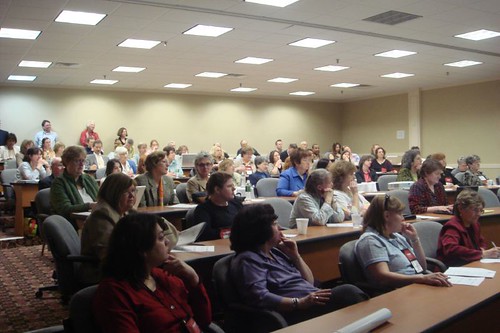
Radical Reference: Community Librarianship and Free/Open Source Technology
Jenna Freedman and Eric Goldhagen
Radical Reference has been providing library services to political activists and independent journalists since July 2004.
[Both presentations are online here]
Radical Reference is a collective of volunteer library workers who believe in social justice and equality.
"You don't have to share my politics. You can just share my tools."
It's not that hard to get started. First, the librarians who shared the political views got together and talked, deciding they wanted to do this. Then, they contacted a Radical Geek list and got them on board for the tech background and support.
Online reference
Online form for questions.
Reference Shelf of information for activists.
There is a collaboration between member librarians to answer questions. Librarians get an RSS feed or an email when questions come in, and then they go and answer them as needed.
They agreed to disagree on large numbers of topics, in the interest of serving the largest number
In the Street
- Ready reference kits, pertinent to the event going on at the time
- Handouts
- Rumor control -- providing real information about what's going on at the event on the ground
- Communications -- providing live-communications while things are going on
Instruction
Conferences, IMC, classroom skillshares on fact-checking, FOIA&FOIL requests, public library resources, advanced net resources, 2.0 tools, open source software
At ALA
Skillshares at Counterpoise -- now SRRT booth -- on police codes, blogging with Bloglines, street reference, alternative libraries, etc.
They need catalogers and tech services librarians, who can answer questions that fall more into those skill sets.
Helping ourselves, too
Community -- LIS Education Forum, Critical Mass, Pride parade
Local collectives -- Autonomous, salons in NYC (activism at work, copyright, race, social forums)
Here's the Boston Guild of Sassy Librarians marching in Pride 2006
Why do this?
Because it's important, and needs to be done. It can't necessarily hurt to have this on your resume if you're organizing and doing reference experience.
Advanced technologies: DRUPAL, chat reference, open source tech
Eric Goldhagen
Free/Open Source Software and Libraries
"With free and open source tools, I don't have to be a pirate."
What is Free/Open Source Software?
GNU and LINUX -- At the beginning (1970s), software was largely in the public domain and the techies thought it should stay that way.
Richard Stallman and Linus Torvalis were the fathers of free operating system -- GNU LINUX
Sotfware is written as text (source code)
Software is most often distributed as an application (binary) that runs in a specific operating systema nd type of hardware (architecture)
Source code is modified (compiled) by another program (compiler) to create a binary
Free software and open source are in most cases equivalent and may be found abbreviated as FOSS, F/OSS, FLOSS
What do you mean free?
Free to read source code and evaluate it for security and other reasons
Free to modify source code for your own use
Free to distribute your modifications
Free to anyone for any use
Free as in speech (always), free as in beer (sometimes)
Opensource.org
Free Software Foundation
"Copyleft" a progressive definition of 'ownership'
Why Should Libraries Care About Software Licenses?
Discussions of software license, fair use and copyright overlap
Creative Commons License for content is an outgrowth of F/OSS
End User License Agreements (EULA) limit rights
Free/open source licenses protect freedom and rights
You never own commercial software
Public access can be restricted by EULAs
Software licenses are a drain on limited library budgets
Knowledge as information to be shared vs. knowledge as property to be hoarded
Benefits of Using F/OSS
Collaboration with other groups -- because there's no restrictions, multiple groups can work on the same projects
Tools designed with you and your uses in mind -- if you need the thing fixed, it's fixed the way you need it and that fix will also be available for other people to use
Localization of economy -- groups work locally with local techies to make things happen
Sharing of resources with other groups
Seeing a connection between services provided at libraries and the tools used to facilitate those services
Open standards -- file formats are important, so if you have your documents in an Open Document format, which can always be converted
No vendor lock-in
Before you jump...
Understand that there's a difference between buying a product forma vendor and hiring a group to modify/customize F/OSS
Think about process, not product
Treat your FOSS team like partners not vendors
Make a wishlist, not an RFP
Take time to evaluate tools before implementing -- is there an active community?, will there be frequent patches?, how well do they respond to non-developers?
Internet Explorer ---> Mozilla Firefox; Opera
MS Word ----> Open Office Writer
MS PowerPoint ----> Open Office Impress
MS Excel ----> Open Office Calc
Oracle, MS SQL Server ----> MySQL,
Adobe Photoshop -----> GIMP
Quark XPress ------> Scribus
AIM ----> GAIM
Quicken -----> GnuCash; TurboCash
Adobe Acrobat ---->
[more]
Content Management Systems, BugTracking Tools, Project Management tools, Constituent & Donor Management, Wiki, Blogs, Tagging
When you get an error message, copy and post it to your blog to commuicate your problems and share knowledge.
Open source software creates a new model. Competition and collaboration enter a new dynamic. Contribution and participation are valued over ownership.
Free Software Foundation
GNU
Open Source Initiative
NOSI (Nonprofit Open Source Initiative)
Linux distributions -- Debian, RedHat, Ubuntu, Gnoppix
Where to find f/oss: Sourceforge.net, Freshmeat.net
People don't notice they're using Open Source tools until you point it out to them. It's almost seamless.
That said, don't try to make the jump wholesale. Make a slow transition and keep your old proprietary softwares as you make the change. Make sure you have a relationship with a techie. We've got to find ways to partner with the techies and not just be the beta testers. The whole point of open source is to take control back, and that's a part of it.
Jenna: jenna at stealthisemail dot com
Eric: eric at openflows dot com
Subscribe to:
Posts (Atom)
