Thursday, May 7, 2009

The 2009 PARA Awards

The Paralibrarian Section of MLA announced their annual awards at their workshop this morning. They give two awards each year, Paralibrarian of the Year and Paralibrarian Advocate of the Year. Denise Faucher presented the following awards:

Paralibrarian of the Year

There were 21 nominees this year. Denise shared the names of the nominees and a bit of information about each person from their nomination, and gave them certificates.

  • Claudette Bright, of the Boston Public Library, whittles away at the backlog cheerfully

  • Laurel Cannon, of the Boston Public Library, has created wonderful connections with teens. They come in to hug her!

  • Julio Chang, of the Boston Public Library IT department, is a “hidden gem” who puts the “help” in helpdesk

  • Melissa Chase, of Bourne Public Library, started a Rock and Read program – 5 local rock bands raised funds for the library

  • Cecilia Darling, of the Maxwell Library at Bridgewater State College, has worked hard supervising students while her supverisor was out on vacation.
    Maryann Dastoli, of the Pittsfield School System Elementary Libraries, takes an annual trip to Tennessee for the National Storytelling Festival and shares new ideas.

  • Betty Emery runs the Supplemental Deposit Collection for the Northeast Massachusetts Regional Library System, and creates close relationships with library vendors.

  • Barbara Diamond Goldin, of the Easthampton Library, provides outstanding patron services despite many constraints.

  • Deborah Jankowski, of the Taconic High School Library, is re-cataloging the entire library while it is being weeded.

  • Barbara Lorentzen, of the Jonathan Bourne Public Library, brings in her own materials to repair books the old-fashioned way – with spine webbing and glue.

  • Hannele Minsk, who works in tech services at the Kingston Public Library, created and ran a teen advisory board for 3 years.

  • Jacqueline Mushinski, of the Gordon Library at WPI, loves to do audio and video editing, and has created podcasts and vodcasts for the library’s website.

  • Judith Poulin, of Easthampton Elementary, served as Grand Marshall of the Easthampton Elementary vocabulary parade – three years after she retired!

  • Susan Robert , of the Blanding Public Library in Rehoboth, organized her town’s first town-wide read.

  • Susan Shaffer, of the Forbes Library in Northampton, always goes above and beyond to help patrons and other staff members.

  • Rusty Shaw , of the Wheeler Memorial Library, proved that no patron request is beyond her consideration - she processes and circulates knitting needles!

  • Joan Sterns, of the Worcester Public Library, meets regularly with other librarians and paralibrarians in her area to discuss the preservation of valuable items in the collection.

  • Donna Tappin, of the Tahanto Middle School Library, is a powerhouse of information and very user-focused, patient, and kind.

  • Mary Ellen West, of the Maxwell Library at Bridgewater State College, has the motto “we can do it and we can prove it”.

  • Kendrah White, of the Temple Israel Library in Boston, always has an “above and beyond” attitude and always goes the extra mile to help patrons or share ideas in the library.

  • Nancy Wilson, of Becket Atheneum works 10+ volunteer hours a week at the library so the staff can offer programming beyond what their budget allows.


Betty Emery is the 2009 Paralibrarian of the Year. Her nominators said that she creates collections of highest quality for the Northeast Region’s Supplemental Deposit Collection, which is housed at the Merrimac Public Library. She seeks out and creates excellent relationships with vendors. Betty is professional, with great attitude, and is always looking for ways to increase circulation. She sends funny, engaging emails to libraries, using fun themes like holidays, sports, or seasonal topics. Last year she even wrote a script and acted it out for the NMRLS Executive Board. Her efforts have increased circulation of the collection by 36%. She plans an annual Open House at the library for the collection, and makes sure everyone leaves with gifts provided by vendors. She maintains a diverse, robust, current collection for NMRLS members. The nominator said Betty took on the task of managing the collection and hasn’t looked back.

Betty commented that she hoped this award is a reflection on the Supplemental Deposit Collection and its impact on smaller libraries in the Northeast Region. She says she started the job 5 years ago, looking for a challenge and something fun. The challenge continues and so does the fun!

Paralibrarian Advocate of the Year


This award is given to a director, supervisor, or paralibrarian who understands the value of paralibrarians in libraries, and works to increase opportunities for paralibrarians.

There were 5 nominations this year:

  • Susan Babb

  • Carolyne Longworth

  • Leslie Todd

  • Michael Somers

  • Michael Colford


The 2009 Paralibrarian Advocate of the Year is Susan Babb. Susan’s nominator pointed out that Susan always holds paralibrarians in the forefront of her work at the Northeast Massachusetts Regional Library System. She teaches workshops specifically for paralibrarians, and makes sure they are represented in all aspects of services provided by the Region. She has worked with the Paralibrarian Section on creating a mission and vision, on the creation of the Book Cart Drill Team Competition, and many other projects. She is a role model for librarians in her Region and across the state. Susan is a supporter, mentor, and friend, who has truly changed lives of those around her.

Drill Teams Rock!

"Sex trumps Violence!" said children's author Mo Willems as he handed out first place to the team that "sexed it up" for the 2nd Annual Massachusetts Book Cart Drill Championships.
In their pink cowgirl duds, the Plymouth library staff, strutted their stuff to "I feel like a woman". The competition was close with the costumed Batman characters of Andover springing their Demco carts into action. And although they took bronze, Methuen sparkled in golden tophats. Demco generously donates gift certificates for their products to the winning libraries and promotes the Book Cart Drill Teams throughout the country. The "Nationals" will be held in Chicago this year at the annual American Library Association Conference in July.

MassAnswers Users Group Meeting

The "hot" news from OCLCs Susan McGlamery was that ALL Massachusetts Libraries can add a Qwidget for QuestionPoint on their web sites. Question Point is the software behind MassAnswers. But how does the average Massachusetts Library without an OCLC account for QuestionPoint get the codes to add this helpful widget? A call to your regional tech guru should be a first contact. For details on how to set up Qwidget, go to


http://www.questionpoint.org/crs/html/help/en/admin/ad_forms_qwidget_setup.html


Installing a Qwidget within a website seems to be the best advertising for MassAnswers because it allows a direct link to QuestionPoint and presents a chatbox.


When you add the Qwidget (QuestionPoint widget) on your library web pages, patrons can easily enter your service. The patron simply sends a message through the Qwidget if chat is available and it goes directly to the MassAnswersQuestionPoint.

OCLC is working on software to allow texting and facbook inquiries to go directly to QuestionPoint, so more patrons will be arriving via web-based services.

The Users Group Meeting was also the venue for the MassAnswers Administrative Team to present reports on usage from academic representative Julie Jersyk and public library representative Eleanor Sathan. Monthly reports show that usage is up, but in addition to encouraging libraries to add a Qwidget to website, it was suggestedthat libraries spread the word by speaking to civic groups.

An interesting statistic from the public library reports was the percentage of questions: 10-24% received between 9 PM and 8 AM.13 minutes average length of questions.

Michael Colford of the Boston Public Library discussed top priorities, including funding issues, which may be changing in this economy.

Speakers: Michael Colford, Regional Administrator, Boston Regional Library System; Julie Jersyk, Coordinator of Reference Services, Northeastern University; Susan Mc-Glamery, Director of QuestionPoint Programs, OCLC; Eleanor Sathan, Coordinator of Reference Services and Regional Reference Librarian, Memorial Hall Library, Andover

Avoiding Déjà Vu All over again: Sustainable Approaches for Managing Academic Library Websites.

Avoiding Déjà Vu All over again: Sustainable Approaches for Managing Academic Library Websites.

Academic librarians

Speakers: Kelcy Shepherd, Digital Interfaces Librarian, University of Massachusetts Amherst Libraries; Gary Atwood, Reference Librarian, Springfield College

Most librarians who are charged with website management are accidental webmasters. They've learned as they've gone along, but get trapped into a redevelopment cycle as the library's web gets stale.

Presenters commended the audience for their vigorous participation.


At UMass many committees and task forces have been responsible. Now they have a content management person who manages Cascading Style Sheet and makes new designs. There's a programmer / systems manager who is responsible for all library technology. There is also a Web advisory committee which is a working group, assignments are given out, they do usability studies, construct Web best practices guidelines which are maintained on a committee wiki.

Questionnaire distributed as discussion starter.

  1. Who is responsible for administering/updating your website? Webmaster? Web team? Other?

  2. How much authority do you have to make changes to your website? None (someone else approves) Some (edit content but no adding new stuff), Masters of domain.

  3. Does your web site have a specific purpose /mission statement Yes, No

  4. Are there design/style guidelines that spell out how the web site should look? Yes, No

  5. Is the library website a part of a larger institutional website (college, school, town)? Yes No

  6. If yes, does the administrator of the institutional we site have control over your web site. Yes No

  7. How would you rate the software you use to administer/update your site? Just right (easy to use, has all you need), OK (you figured out the basics, but the advanced stuff requires more training), Where's the manual (difficult to use, more sophisticated than what you need)

Think about your library website. Ask What is the purpose of the website -- Ask Who is the audience. Then

Think carefully about choosing a content management system. UMass Amherst uses

Silverstripe. http://www.silverstripe.com/ Many colleges use Drupal which was a little too tech heavy. There are some quirks that require workarounds.

It is a good idea to do usability testing. Others' eyes can be helpful.

Kathy Shepherd can be emailed kshepher@libary.umass.edu if you would like to receive UMass' Best Practices Guidelines and the Website Mission Statement which is kept on the committee wiki.

Brenda

19th Biennial MLA Public Relations Awards

The Public Relations Awards Ceremony honors the best public relations materials from
Massachusetts libraries, as chosen by a panel of distinguished judges.

The event was well attended and flowed efficiently, which is all that can really be asked of an award ceremony. There were many awards given in a myriad of categories, but the most rewarding part of the ceremony was the atmosphere.

As each award winner approached the stage, their pride in their profession and passion for library service was evident. After the ceremony, attendees took every opportunity to congratulate the winners; the mutual support amongst library professionals was palpable. Given the economic climate, it is especially heartening to be surrounded by such positivity.

The ceremony was presented by Co-Chairs of Massachusetts Library Association Public Relations Committee, Laurie Lessner (SAILS) and Greg Pronevitz (NEMRLS).

There were far more awards than would be reasonable to report here, but within a week MLA will post the winners of each category, photos, and a model press release for libraries who won awards on their website:
http://www.masslib.org/PRAward09

Rebecca Krznarich, Reference and Adult Services Librarian, Whitman Public Library

Creating Informed Library Spaces Through User-Focused Discovery and Assessment

Creating Informed Library Spaces Through User-Focused Discovery and Assessment

The Georgia Tech Library has created two award-winning commons spaces and is in the final design process for a third commons. With each project, the Library has continued to refine its methods of incorporating user input in designing spaces and then assessing the effectiveness of those designs. The transparent and inclusive nature of this process has won praise and has helped create spaces that truly meet the evolving needs of end users.

Speaker: Bob Fox is the Associate Director for Public and Administrative Services at Georgia Tech University

The library already had two award winning commons. The new area is open 24/5 Sunday through Friday. Some features: Multimedia studio, productivity clusters with 85 workstations, collaborative computing, a rehearsal studio, a presentation area with fliptop tables on wheels which can be configured for collaboration or to maximize available space. No set furniture, even in the theatre area. Even soft seating has wheels.

Reference is in the East Commons now. Circulation desk moved over to the tower. Librarians assigned to this area are a little more software and hardware savvy. There's a training boot camp for library assistants. . 10pm-2am are peak times of use.

Library West Commons and Multimedia studio.

Examples of engagement:

They have been engaging their students on Facebook Georgia Tech Library http://www.facebook.com/pages/Atlanta-GA/Georgia-Tech-Library/8264471191 We're working on a visual identity for the library. We'd like your feedback. http://forums.library.gatech.edu/viewforum.php?f=11

Make your mark on the GT Library!

We need your help. The George Tech Library is looking for a visual identity. Send us your original sketches, graphics, logos, symbols, or any other ideas that can be used online, in print, and in the Library...

They have a student advisory board of 8-10 students. They try to recruit student leaders. Current board members can nominate their sucessors. They meet twice a week.

They are reluctant to put up online survey because students hate to be interrupted with popups. Though here's one http://librarycommons.gatech.edu/

During construction, they keep students up to date on availability

Real-time availability map:

LWC:

Available: 82

In-use: 3

Unavailable: 4

LEC:

Available: 21

In-use: 15

Unavailable: 0

The held about 30 focus groups

The Georgia Tech website has a number of planning documents available including Herman Miller case study overhead grid system and focus groups. http://librarycommons.gatech.edu/about/documents.php

After the spaces are used, they did yearly then longitudinal observational studies. 4 times per day to document where students were and if they were using a laptop or mobile device. Students did a DVD chronicling the development of the commons area zones.

They relocated IT help into the library resource center and more students used the area, brought in their laptops etc. than when the help desk was located over in IT. Usage is up and collaboration is alive and well at Georgia Tech.

Brenda


How the Way We Talk Can Change The Way We Work

Thursday 2:00 PM
How the Way We Talk Can Change The Way We Work
Presenters: Beth McNeil & Barbara Preece


Change is a commitment to work and an ongoing process (for everyone)...

The presenters created a Communication Toolbox (exercise) to help analyze self and environment, and to work towards sustainable change. Adapted from Kegan, Robert and Lahey, Lisa Laskow. How the way we talk can change the way we work: seven languages for transformation.

Think of the number of times people walked out of a meeting with completely different perspectives about the discussion and outcomes of the meeting, or about the assumptions that you have made based upon the events that transpired.

Attendees shared their New Year's Resolutions, work related resolutions, as examples of how we want to affect change. How do we stop complaining and move towards making changes and commitments?

Examples of complaints from the audience...how do we accept different work styles, bullying in the workplace, bringing personal expectations into the workplace, entrenchment among librarians that do not want to change, lack of acceptance of changing realities.

Pay attention to the complaints because they are about things we care about. Finding someone to complain to is a helpful release, but it does not create change.

Communication Toolbox Exercise...
Language of Blame...What is your complaint (i.e. I disagree with my director about the direction of reference services at the library)? Next, change your complaint into a statement of commitment (i.e. I am committed to a high level reference services.)

This first part shows what people care about most and to what they are most committed.

Language of Personal Responsibility...Current state (what is holding you back) - What I'm doing or not that prevents my commitment from being fully realized. Who - What individuals are involved in this process?

Competing Commitment (i.e. not fighting a losing battle) - I may also be committed to... Big Assumption (i.e. I cannot convince them of the legitimacy of my perspective) - I assume that if...

Often there is the "dreaded changing of the work flow", people are really afraid that if they change the work flow that the level of service will decline. They are resistant to change out of a commitment to what they perceive as already being a high level of service.

1st Action - I will test my assumption by (i.e. I will give them the responsibility, but they may not be experienced enough)...Outcome - What happened when I tested my assumption (i.e. I showed them how to do it, they are capable, and it is saving me time.).

Parable of the Abeleen Paradox... Four adults sitting on a porch in hot temps near Abeleen, TX. A married couple and their parents, a suggestion is made to drive to Abeleen for lunch, they go in a non-air conditioned car, have a terrible lunch, and return cranky. They then learn that none of them wanted to go in the first place, who should have communicated about this and why?

From the Audience...a greater commitment to continuing to try and make changes.

Black belt librarians: dealing with challenging patrons


More pictures are on flickr.

2-3:15 PM, Meeting Room 2, Thursday, 5/7

Warren Graham is a security professional who works with "the reality impaired".

"How to walk up to a perfect stranger and tell them to knock it off while protecting your safety" is the main topic today.

His background is in the library in Charlotte, NC. The old building, which closed in the 90s, had all sorts of security problems, including childhood assault in the bathroom. Private security firms failed so the director hired Warren.

"If you do not deny access to people who are destroying the library you are denying patrons to your regular patrons.... Just because its a public library doesn't give you license to build a fire in the middle of the floor.... Don't let the inmates run the assylum, you have a right to a safe workplace.... You deserve to be treated as the professional you are. Its not right not to feel empowered not to tolerate abuse.... It's way past time in the library world to start making patrons more responsible for their behavior."

Solid and simple is better than over-intellectualized meetings full of pontifications that go nowhere. Thick security manuals that say nothing are useless. They should be lean and simple.

Everyone has to be trained properly.

Rules have to be enforced consistently by everyone.

Everyone has to be treated the same. The same consequences have to apply to everyone.

3 things that make a security program effective:

1. Must have simple, strait forward rules for library use.

Examples of stupid rules "no prostitution", "Causing intentional alarm by indecent exposure".

One rule every library should have: Any behavior that is disruptive to library use it not allowed. This rule can replace TONS of other rules.

Problem patrons are only 1-2% of library patrons but most of these hard line behavior problems only understand a hard line.

Administration has to back up staff. There are always exceptions but that should be rare.

2. Consistency is critical - between staff, branches, everywhere.

3. Always apply rules based upon BEHAVIOR not APPEARANCE.

Be careful with loose talk around the library. People listen and observe all the time. "These street people... these banking yuppies from hell.... these Satan's spawn... that little monkey on acid - one more time and that kid's out" DON'T SAY THESE THINGS!

How to tell someone NO:

1. Approach with a confident frame of mind.

Most people comply if you approach them correctly. Its not about confrontation its about communication. Its not policing, its advising patrons as to what's not allowed in the library. Relax when you go up to a patron. Too tense and you'll over-react. Give them the benefit of the doubt.

2. Start nice and you can get tougher if you have to. You can't come on too strong and then ease off.

Whenever approach someone for the first time, usually for something minor start "I don't you didn't see the sign, but............." or "I know you didn't know, but.....". This gives the patrons an out so they don't feel like an absolute idiot. Make sure they know you're giving them the benefit of the doubt.

Stop saying sorry. Just say "I know you didn't know". Apologizing opens the topic up to conversation and conflict.

Do not be a helicopter librarian. Tell them, thank them, then move on. Check back in a few minutes to make sure things are ok. Don't just stand there and hover.

3. When you approach people, exercise prudent caution.

Blend this together with confidence. Confidently cautious and cautiously confident. Whenever telling someone NO, keep any barrier you can between you and that patron. Don't even give up chairs, floor plants, desks, book carts, any barrier is good.

Don't forget about personal space. A stressed out, upset, or disturbed person is even more sensitive about personal space. Close enough to touch is too close. Never touch anyone except in self-defense.

If someone is sleeping and you need to check on them, go up, stay on the other side of the table ad ask if the patron is ok - express concern for their health. Don't assume they are hearing impaired just because they are asleep. You don't want to startle them and give them cause to explode. If they are still asleep, lightly tap the table - but be gentle, with a head on a table it will be amplified. If you still can't wake someone up, call 911.

WHENEVER you tell someone no, do not immediately turn your back. No matter how nice they have been, you don't want to put yourself in that vulnerable of a position. Appearances mean NOTHING when it comes to trouble. Be slick about walking away - look at your watch as you walk away to keep them in the corner of their eye, turn around and scan the room as if looking towards something else, be discrete and don't come off as obviously watching them, but don't let them out of your sight until you're safely away.

4. It doesn't matter if you're telling someone no or not, whenever you discover drunk or otherwise chemically incapacitated, they need to go. Smelling booze is not the same, its when they are obviously drunk or high that its time to call 911 and for that person to go.

Regardless of outside conditions, other patrons don't want incapacitated patrons around. No one is harmless when under the influence.

5. Everyone has to tell someone NO sooner or later. Someone is going to take exception. The experienced behavior problem knows that if they can upset you they can control you. Don't let them break your mental rhythm.

Tell someone no and only three things can happen:
a. they comply
b. they leave
c. they say no they won't comply and won't leave - and you have a plan for how to deal with this as well.

6. Never argue with a patron.

A lot of people are very good at pointless arguments. Don't engage. If they keep on trying to wear you down they are being disruptive and need to leave.

Sooner or later you will be accused of some sort of bias. Everyone can come in, but everyone has to follow the same rules. The person you're saying no to could be a victim of past bias. Most of the time, they just want to throw you off. Just treat everyone the same and stay on topic. Don't respond to accusations of bias.

Teen areas are GREAT. When you want to be a destination of choice for youth, remember:
most kids are good kids
most problems with kids are caused by STAFF fears, problems, and dislikes
even big kids are still kids with kid fears and insecurities. They don't want to let people know they are afraid and say silly things to hide this.

Actively manage the room - acknowledge teens, make sure they're doing ok. Be casual and relaxed. Some kids need extra warnings but all the same, disruptive behavior is not acceptable from anyone and adults have a right to use the library as well.

7. Never go outside with a behavior problem.

The front door is the limit. Once outside people feel emboldened to do things they wouldn't consider inside. Standing just outside the doorway is ok if you need to get a license plate number for example, but stay in the doorway. Stay cool and stand guard over yourself. Do not chase thieves out of the library.

8. Before you go and correct someone's behavior, make sure you have the right person.

There's an ocean of difference between suspicion and guilt. You have to be aware of something happening. Then just keep communicating with people in house, share suspicions, be PATIENT and sooner rather than later you'll figure out what's going on.

The single most important thing to take from this session:

Awareness is the best security tool. Ultimately your safety is in your own hands.

Practice 30/30/30. For the next 30 days stop every 30 minutes and look around for 30 seconds. This will heighten your intuition and help raise your guard.

No matter how small your community, if there's one village idiot, he WILL come to your library. Be prepared. Have a plan. Your security plan is just as important as your circulation procedures.

Warren's website: www.blackbeltlibrarians.com

Q&A:

When the alarm goes off on the security system, you must respond every time. Refine your guidelines so you know how to react when you catch someone. Theft of library materials is a serious matter. Treat it as such. Say: "When the alarm goes off I just need to check. Its probably our fault and we didn't deactivate something."

When the kids go outside they all stand in the foyer and block traffic into the library. Just open the front door and go out a few feet. Its best to go with someone or have someone watch you even then.

Mo Willems


2:00-3:15 Mo Willems

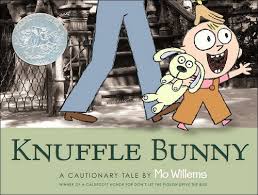
Speaker: #1 New York Times Bestselling author and illustrator Mo Willems is best known for his Caldecott Honor winning picture books Don’t Let the Pigeon Drive the Bus!, Knuffle Bunny: A Cautionary Tale, and Knuffle Bunny Too: A Case of Mistaken Identity.

Mo Willems Homepage

The Mo I did not know . . .Mo was a writer for Sesame Street and won 6 Emmys. Mo is also working on a musical based on his Knuffle Bunny book. Mo, a rather dynamic speaker, started his lecture with a story. Mo did a rendition of the three little pigs. Mo stated at the end that he would never create a book around the three pigs story. The audience must create the meaning of his story.

Mo says that for a picture book to be successful it must be incomprehensible. With the three little pigs, everyone can picture what will happen and has preconceived notions of the story. Mo mixed up the story and the ending, but makes the point that he wants everyone to get out of his picture books what they want to get out of it.

Mo talks about readers not wanting a relationship with the author, but a relationship with the characters. Mo wants to make sure he is not present in the story. He wants to create an emotional placement with the characters, as in "Where the Wild Things Are" the reader does not notice the characters getting larger and larger. If you do notice, the author/illustrator has failed.

Mo also talks about manipulating the reader into the rhythm of the story by playing with the words and the length of the phrasing on each page. Mo leads into a discussion about one of the rules for his books: all of his books must have characters that can be drawn by a five year old. Mo wants children to feel like they can infringe on his copyright. Mo takes a moment to pass out paper to the audience to practice drawing like a five year old using basic shapes and concepts. Mo even makes "kiddy" noises while he draws indicating how much fun he is having, "honk, honk!" Mo draws a pigeon with everyone in the audience, imploring all to show him their picture. Mo points out the fact that every pigeon is different. Mo talks about the traditions of cartooning as a combination of English and American caricature and Japanese calligraphy.

One member of the audience asked how Mo came up with the name von hooby dooby. Mo uses the phrase for things he forgets.
Mo reflects on his third grade art teacher who threw all of his drawings away. When Mo went to high school his third grade teacher had taken a job at the high school, so Mo never took another art class. Mo got a Bachelors degree in film, but tells all that anyone can become an illustrator: it is the desire that is most important of all.
Mo explains that he got his first book published in 5 years—it was rejected by 74 million publishers. All the publishers said the book was unusual. The last publisher thought the books unusual nature was a good thing and decided to publish it. Don’t worry about getting published, work on being superlative and someone will find you.
One of the most intriguing stories Mo relates is when he was a child he wrote a letter to Charles Schulz asking if he could have his job when he dies. Mo waited for years for a response, until not long ago Charles Schulz passed away. Mo was talking to his father and mentioned, "Remember when I wrote that letter to Charles Schulz?" Mo's father responded, "Yeah, we should have sent that letter." Mo relates that it is a very Charlie Brown moment. Mo, of course, thought the letter had been sent and was disappointed to learn he waited for naught.

Mo ends his talk with the world's worst poem. Mo does a lot of traveling and reflected on a lousy ditty in the bathroom of a hotel that communicates the power of the word, however bad, even the word discourages the stealing of towels.

Here is a blog of some of Mo's doodlings: Doodle blog

HELP! I'm so STRESSED!

11:30-12:45; Meeting Room 4

This session started with everyone filling out a self-assessment of their personal stress level that was designed to measure personal vulnerability to stress.

Stress is a function of events, attitude, and behavior. We can most control attitude. There are many physical reaction we experience when under stress. Its very hard for our bodies to manage all these experiences. There are also emotion and cognitive effects. Recognizing the effects stress have on you is a good way to clue into the need for stress management. Standard stressors include: work., family/relationships, finances, changing schedules, illness, substance abuse, care taking others, need to be "perfect", and loneliness. Its ok to be good enough. Defining what good enough means can help a lot to reduce unrealistic expectations. The audience also contributed the following as stressors: school, loss of significant people in your life, moving, seasons (winter), work transitions, media / news (turn it off!), keeping up with technology (and just keeping up in general), housework (laundry, home maintenance, etc.), daily little things (catching a train, keeping track of your keys...), noise, technology failures, and guilt ("one of the more useless emotions there is, throw it all out!").

What gets in the way of stress management? Never enough time, caring for others, isolation, poor diet, too little exercise, keeping score (why aren't they doing their share while I'm doing so much?), loss of perspective (you have to continually prioritize), drinking too much, too little sleep. The audience contributed: ever increasing work loads, shrinking work forces / layoffs, and feeling constantly overloaded to the point of inertia setting in (give yourself permission to ignore stress), and feeling that we have to be connected electronically 24/7,

A useful tool - do only one thing at a time - when eating, just eat, don't do anything else. Meditation also works for several people. Taking a FIVE minute break can be very helpful. Its very short and can make a great difference.

Laura doesn't have internet at home and has "trained" all her friends to call her if they need her outside work hours.

Its important to establish a personal support network. Potential sources include: family, friends, community, work network, and professional help. An audience member expressed discomfort with co-workers sharing too much personal information. Laura addressed this with the need to establish limits and acknowledged that this can be a tricky environment. Another audience member talked about the role spiritual and religious groups can play as part of a support network.

Skills to cope:
Logistics: planning, organizing, communicating, setting limits, delegating, establishing support.
Physical: breathing, stretching, visualization, meditation, progressive relaxation.
Other important skills include: establishing time limits for activities and conversations, redirecting conversations to clarify what role you are filling, managing interruptions ("give me five minutes" be or "lets schedule a time to discuss this"), using visual displays to indicate availability (green/red door hangers for free/busy so can close door and indicate ability to be interrupted or not), setting specific agendas, and holding regular meetings to conduct specific types of conversations that don't need to happen immediately.

"You have a right to set a limit to what you are doing."

An instant piece of control can be obtained through some physical tools. Daily meditation allows the brain to have a chance to detox and changes Laura's ability to manage stress. Just breathing and slowing down your heart rate is powerful. Daily meditation develops the ability to instantly enter a meditative state.

The audience was led through a progressive relaxation exercise. They sat straight, put feet flat on the floor, closed their eyes, and relaxed with heavy hands. Laura talked people through thinking about their body, starting with the top of the head, through the temples, the eyes, paying attention to breathing, relaxing the brow, going down to the cheeks, lips, nose, and this relaxes your entire head. Laura continued to talk the audience through relaxing their shoulders, back, and on down through their feet to the floor. This went on for approximately 5 minutes. It ended with each person being encouraged to take three breathes and open their eyes. She described this as a "body scan" and encouraged everyone to do this at any time they felt stress.

Manage Up!

11:30-12:45 Thursday, May 7, 2009 Manage Up!

Speaker: Diane Young, Library Consultant (Itinerant Librarian for the Mass Lib Association)

Diane offers an interactive workshop on how to manage your boss, or rather, how to convince your boss to say yes. There is always a superior and a subordinate. The superior, however, always has the upper hand. Even if you have a really great boss, you will always hit a wall in getting what you want/need. Diane stresses that every human being is fallible. Diane states that there are 8 things/steps to consider in communicating with your boss. Diane created an acronym--"INTREPID"--but it does not quite translate below as she lists the points out of order.

1. Issues

What are your boss's favorite issues? What is your boss excited about? What is it that your boss talks about or is passionate about? Diane opened this question up to the audience. Responses included furniture, degrees, databases and workshops. How do we know what our boss is interested in? The audience stated that they talk to co-workers, talked to their boss at meetings, saw initiatives their boss was working on.

2. Pressures

What are the pressures on your boss? Some responses include budgeting challenges, negotiating licensing with vendors, personality conflicts and faculty relationships.

3. Ramifications

How does your idea affect other divisions? The budget? The customers?
On member of the audience talked about her trouble in getting new stacks for the children's room. She is conscious of taking money away from others. She sees the problem: the stacks are dangerous, when will they be fixed. Another audience member discussed the challenges of getting a wiki for the children's room to document schedules and usage.

4. Non-threatening

How can you make your idea non-threatening? Incremental? No cost? Can you do it for a trial without including a cost? Diane thinks this is pretty straightforward. The problem, as one audeience member states, is that many people find any idea that is different as threatening.

5. Dignity

How will you respect your boss's dignity? How can you make your boss look good and feel good? Be mindful of your boss's image and feelings. Diane suggests that it wouldn't hurt to appear deferential by considering how a proposal or idea could help your boss's image

6. Empathy

The operative word is empathy. Praise upward. Diane uses the example of your boss laying off a staff member and acknowledging the difficulty of the situation. Empathy makes your boss listen, too.

7. Information

How does your boss like to receive information? Diane had a boss who interpreted Meyers-Briggs test results to effectively communicate with staff, respecting the way staff wanted to interact based on the Meyers-Briggs test results.
Diane also urges us to understand if our boss is a detail-oriented person or a big-picture oriented person.

8. Timing

Is your boss casual or strict about his time used? So how should you use time communicating your idea? This sort of falls under Information and the way your boss would like to communicate.

Diane then issues an assignment and gets the room to break down into different groups. Given an idea, a boss's issue, pressure, and preference for communication and timing, Diane invites groups to consider what they will say. What medium will each group use to convey the message? When will each group say it?

Each group presented one or two clever things they would say to their boss. One group proposed dropping the idea like a bombshell and letting their boss think about it for awhile before coming back to it.

Another group proposed the use of a wiki as being able to better serve the community to align with their boss's interest in serving the community. Another group made a case for allowing beverages in the library to minimize staffing problems at the circulation desk because there is less policing and more attention at the desk. Such a proposal would capitalize on their boss's predilection for organization and simple solutions.

Diane, of course, says to think before you leap. I guess we should add that it is important think about your boss before you leap. Maybe you can just try leaping on your boss--figuratively speaking. Give it a try!

Information Literacy Showcase: Effective Practices from Public, Academic, and School Libraries

Information Literacy Showcase: Effective Practices from Public, Academic, and School Libraries

Looking for new ideas to build or enhance the information literacy program at your library? During this session, panelists will share examples of teaching and learning strategies and technologies that have been successful with key library audiences, such as young adults, college freshmen, and senior citizens. Stop by the Teaching and Learning Center afterwards to meet the panelists and learn more about their programs.

Moderator: Kelly Jo Woodside, Information Literacy Librarian, Simmons College. Panelists : Sara Marks of Fitchburg State, Julie Krass Westwood Schools, Daniel Barbour Shrewsbury Public Library, Matthew Jaquith Springfield Public Library.

Jaquith

Springfield Public Library Reference. Formerly @ Brown.

Information Literacy is the a competency find, decipher, manage and share information in our society. Adapted from ODLIS : Online dictionary for library and information science by Joan Reitz. See http://lu.com/odlis/about.cfm

Also from ODLIS: Media Literacy defined: The ability to access, analyze, evaluate, and create messages in a variety of forms (print, audio, film/video, Internet, etc.) based on an informed, critical understanding of the nature of mass media, the techniques used by producers of media, and the impact of those techniques on the individual and society. An interdisciplinary field, media literacy has evolved as a necessary response to the complex, pervasive, ever-changing electronic communication environment of the 21st century. Click here to connect to the homepage of the Center for Media Literacy. Compare with information literacy.


Classes @ SPL http://www.springfieldlibrary.org/hitech.html

Why should public libraries teach information literacy? Information is a society need. People have different levels of need. Spectrum of literacy topics: Information literacy - He does a readers' advisory class using novelist - using OPACs etc to find materials using relevancy, bibliographic instruction - database use, Many classes at Springfield focus on basic computer literacy- there's a typing class a word, excel, powerpoint classes usually 2 session, 90minutes each, folder management. typing class has been very popular. media literacy- browsing, searching in many areas to find actually useful information.


Barbour - Shrewsbury PL http://www.shrewsbury-ma.gov/department/division.php?fDD=17-53

Uses his communication and marketing background to attract YAs

Some of his fun programs for grades 5-12: scavenger hunts (treasure hunts, haunted house themes), races. Teens hate bookgroups, Kings and Queens Grant teaching how to write. Natalie Perkins lead groups. She's has written First Daughter serues. Filmed them reading what they have written, then kids vote on the library blog. Shrewsbury PL checks out games. After the games were in the library, book circulation actually increased 25%. They have an IMLS grant which provides a shuttle service from the Middle School. They have a SPLAT advisory team. They have a manga collection development group which recommends books for purchase. They use Tutor.com to offer online tutoring.


Krass - Information Literacy in the Elementary School Libary. Westwood Schools.

She recommends starting early. Kindergartners learn the difference between fiction and non-fiction through readalouds. They play a fiction came. Children make up something fictional. She uses rhythm and a little song: Numbers mean nonfiction. She recommends the Jenkins book Actual size (Jenkins, Steve. Actual Size. Boston: Houghton Mifflin, 2004. ) with a document camera.


First Grade children learn sections in the library- Easy, etc. ; Children collaborate to create a table of contents for nonfiction; learning about favorite authors. She uses picture Icons to create an easy bibliography.


Marks Fitchburg State College Library

See her bookmarks at http://delicious.com/librarygurl/mla09


Sara's opinion: College students don't spend their time using traditional research methods. They crave interactivity and online access. Collaborative knowledge is growing. Librarians should quit fighting Wikipedia because this is a battle that will ultimately not be won. Better to teach how to evaluate materials critically. Eventually, collaborative wiki types of information will be mainstream as the value of collective knowledge becomes the norm in many fields.


LibGuides http://www.springshare.com/libguides/

LibGuides concentrate on ACCESS, feature media, accessible

Statistics available from LibGuide, have just added Google Analytics, so there will be more.

Very good support from folks who know libraries, hosted by LibGuides. Library A la Carte. Free, but you have to have very good resident IT tech support.

Cost for LibGuides. At $900/year, nothing pays better.

Their cost for Academic Search Premier $.27/search, Credo $.40/search, Libguides $.04/search.

After implementing, there was a slight increase in database use and a notable increase in Academic OneFile.

Ask a Librarian makes a live Meebo chat connection on the right sidebar, there's a twitter aspect

They have the ability to use delicious and digg, but they don't use

They have embedded a quick opac search widget.


Most popular, blackboard Libguide - There is a tour of the library on YouTube which is embedded.


They add Libguides to Blackboard.

BROWSE http://fsc.libguides.com/browse.php


Outcomes and rubrics for information literacy are there. http://fsc.libguides.com/content.php?pid=6334

Crime on Television is a Libguide. http://fsc.libguides.com/content.php?pid=23758

Web 2.0 Brownbag series http://fsc.libguides.com/web20

Blackboard LibGuide http://fsc.libguides.com/content.php?pid=2346 includes a video college tour which is on Youtube.

Source citations http://fsc.libguides.com/content.php?pid=4896

Advanced Research methods. http://fsc.libguides.com/content.php?pid=37164

ALA Let's talk about it Discussion series is on a libguide http://fsc.libguides.com/LTAI involves the community as well as the college.

- Brenda


Booktalking 10 Ways

Donna Johns, librarian at Newton North High School, is reaching teens 'One Teen At a Time." There are many ways to make booktalks more exciting and Donna shared these ways with a large audience on Thursday morning at 9:30 am in Ballroom B.  Using PowerPoint, Donna used twenty slides and her own voice to give us an twenty-second booktalks.  Each booktalk focused on one image which created visual interest.  
Booktalking 10 Ways:
  1. Keep It To Twenty Seconds
  2. Scaffold for Different Kinds of Readers (non-fiction and magazine readers are readers, too!
  3. Differentiate Instruction
  4. Podcast It! (Gcast.com, etc.)
  5. Blog It!
  6. Create Master Booklists (using Library Thing or Shelfari)
  7. Online Book Clubs and Discussions (Dear Reader, etc.)
  8. Use Wikis (to build a collaborative community - PBWorks.com or WebPaint.com)
  9. Build Book Trailers (throw some slides into imovie, add text and an audio track)
  10. Enrich Your Displays (use great items such as a toast with books in it)
If you have questions for Donna, you can email her at mamasigs126@gmail.com

Donnas has two blogs: Looking for a Good Book? and Libraries4Teens.

Libraries and Learning: A History of Paradigm Change

9:30-10:45 May 7, 2009 Libraries and Learning: A History of Paradigm Change

Scott Bennett is Yale University Librarian Emeritus. Check out more information at: www.libraryspaceplanning.com


Mr.Bennett began discussing three revolutions in communications technology that have created paradigms in library space. All three dictate paradigms of library design: (1) reader-centered design/paradigm, (2) book centered design/paradigm, and (3)learning-centered paradigm (end of book-centered design).

The reader-centered paradigm can be seen in many traditional libraries that were designed to affirm the unity of readers and books. Books were in close proximity to the reader, and spaces were open and conducive to study and reading. The spaces were not dominated by shelving. see Yale University Library

The book-centered paradigm showcases a library overrun with book stacks, as books were central to the idea of a library building. An example of this is the main library, University of Illinois. Check these out on flickr: Uillinois

Scott talks about the end of the book-centered paradigm (learning-centered paradigm) as informing new library spaces and perhaps a flexible model for design in libraries. The tipping point came in the early 1990s through the early 2000s with the design and introduction of Journal Storage with the likes of JSTOR. With electronic resources came a shift in spatial relationships between students and the library. New study spaces are required and this clearly signaled the end of the book-centered paradigm. This paradigm clearly points to the information commons model. The Vogel Library, Wartburg College employs an information commons, but the planning process asked: what do we want to happen in this building? The answer: "We want to make learning happen." With this answer, the Vogel Library incorporates space on the third floor of the library with no print material, moving away from the model of book-centered design. The idea, as reported by Mr. Bennett, is that studying equates to learning. Learning is controlled, described as a transformative moment in which students WANT to learn. Scott uses the term "metacognition", or the ability to orchestrate ones learning. It is also referred to as "intentional learning." It employs an end rather than a means.

These are certainly lofty goals for a library--designing for intentional learning, as Scott relates. New design has the intention of fostering intentional learning. Autonomous learning has rarely been a goal in designing a new library space. Group study spaces, cafes, learning spaces do not comprise intentional learning spaces. The element of participation and community are required for contributing to the space and the intention of learning.

We need to think like educators rather than like service providers. the book-centered design is geared toward information. We no longer "support" students, but instead actively participate in the education process by making education intentional.

Make the library as a cheap place on campus for students to take control of their learning. Take advantage of the revolutionary moment employing a learning-centered paradigm in which education and learning are intentional, not peripheral. The librarian must not act as supporting architects in assisting the student, but as primary architects in designing the students.

A systematic understanding of learning informs our ideas of design for a library. It is clear that traditional methods of design of space will produce poor returns on investment in physical library space.

To borrow Scott's words from a statement on his website: "I believe that, properly done, library space design situates information in the social context of learning. This synergistic situating of information and learning is the core function of a bricks and mortar library, and it aligns both the library and its building with the basic educational mission of the college or university."

Essentially we are talking about a future of flexibility in library design. It seems that the new model of library design is like technology: it is everywhere and nowhere. In any case, it changes our notions of the way things "should be".

MassCat's move to open source software: An update


9:30-10:45 AM, Thursday, May 7, Meeting Room 5
More pictures available on flickr.

Nora Blake's Powerpoint presentation will be posted later.

MassCat has around 90 libraries, mostly schools, that pool resources and are ot a part of the other library networks in the state.

It started live full force with Koha in the fall of 2008 with over 1,200,000 holdings. They signed with LibLime to partner in the migration. They had to break down the existing catalog into individual files for each member library. To distinguish each library they had to add prefixes onto each barcode. Because they didn't want every library to have to replace their barcodes the searching by barcode requires filters and/or keyword searching.

The catalog started with over 625,000 records, but many were duplicates and it was not as clean as they would have liked because of how things had to be broken down by library.

Why Open Source? They had a direct influence on the development of the software and benefited from the work lots of other people are also doing to develop it.

They chose Koha after looking at Evergreen. Koha's OPAC was more attractive, had an integrated serials management system, a clean staff interface, was entirely web-based (no software downloads for clients). Looking forward to a 3.2 release this summer.

Link to OPAC: masscat.kohalibrary.com

Currently, can't search a group within a group. To scope a search to a specific library's collection, each library has a unique URL from which they can broaden they search. They working on developing more sophisticated searches defined by geographical areas - likely to be a drop down search option.

Nora would prefer a larger font in the OPAC, but this is fairly easily changed by browser customization. Book jacket covers come for free - using Amazon. The downside is it just searches by ISBN and grabs the first result. Sometimes this returns no image.

The main page has a "lists" tab and the public lists display all the public lists, they currently can't be limited to just one library's. Patrons can create private lists. (Lists are for bibliographies).

Students are using the comments attached to books. To create a comment you have to login and they're reviewed by library staff before they are posted.

For holds, the pickup location can be changed from the location of the owning library, but in this network this is not often done. Notification of when holds are available for pickup is an opt-in email notification system. This can also be controlled from the staff side. Libraries can also create event notifications and use the same email system to send these out. With the addition of another company, text messaging can also be added into this system. Masscat is looking into doing this next year.

The staff interface has a news section on the home page which is used for communication with the participating libraries. A current problem: management of holds that can not be filled is not really working - if a library can't fill a hold they mark it as such, but it just sits in their hold queue. There are work-arounds that libraries are using, but an integrated solution is hopefully in development.

Under Circulation reports there are two holds links: a queue and "to pull". The "to pull" is not what it sounds like and will hopefully go away with the next release.

You can load images for patrons to associate with their account, individually or in a batch.

In the 3.2 release they are working on audible clues, especially helpful when on the front line for flags - such as fines, notes, etc.

A big shift: the system automatically emails overdue notices. If no email address is associated with a patron's account an email is sent to the library's email address. This presents some logistical issues in the schools and has required that they change their workflows a bit.

A tool that MassCat created was a shortcut to a z39.50 search. This search was available before but buried. This is in addition to the three primary types of searching: basic, advanced, and catalog. When you execute a z39.50 search you get a pop up window that lets you refine your search and check off the libraries whose collection you want to search. Member libraries have discontinued their OCLC accounts as a cost savings, but Nora still has one and can use it to look beyond the libraries in the list. Once an acceptable record is found via a z39.50 search its just one click to import the MARC record.

They've found that Koha has a lot of development still to do and a lot of what they expected wasn't actually there, at least not in a usable form. It works, but there are areas, especially around holds, that still need a lot of work. Its complicated because a lot of libraries are using it as a Union catalog and aren't actually using it as a live system - so it can't display real time status for their items.

They had expected a faster new release cycle than what is typically provided from proprietary vendors, but so far, this hasn't been the case. However, bug fixes and improvements are made "fairly frequently". Another big difference is that since its open source, the faults are much more widely known - there's nothing to be gained by hiding them.

The Koha community elects a "release management". The entire process for how improvements are agreed upon to include in a release isn't clear. Its done in committee meetings and Nora is confident that the improvements that she's made will be included in the next release. LibLime is the tech support that MassCat has contracted with. Some local public libraries have tried using Koha alone. It would require a lot more staff and time to do it without LibLime. Nora said she would need to hire at least one more staff person with a more technical skill set were they to consider going it alone.

There a lot of supporting email lists and web sites that are in the powerpoint presentation which will be linked to once its online.

They did not find training material that would work for their needs, so they created their own.

The virtual catalog is in development and MassCat is waiting to see how this develops to find out how they can work together.

Reporting: there's a lot of "out of the box" reports in addition to the ability to create customized sql reports. On the Koha wiki community members are sharing their sql reports so others can benefit.

In summary: its much better than what was before. The transition wasn't easy and "not the BEST thing we've ever done" but Nora's happy with it and believes most of the contributing libraries are as well and they're certainly sticking with it.