Funny how all the teens that Stephen Abram interviews seem to love books as much as computers.
"I shouldn't go to bookstores. Everything looks good. Even the one's with hardcovers still look good."
"A book only lasts me a day. I use the school library, but I can't remember when I last went to the public library."
"I can't pass up a bookstore."
"I use Amazon.com, check out the back and front of the cover and read a chapter."
"My public library is very organized: They separate the romance from the other books."
"I go to the library because its quiet, to get a encyclopedia, "
"In the school library at my senior high, everything is new, lots of computers, but the books are old, paperbacks that are yellowing. People don't go there for the books"
"I don't go very much to the public library because I go "overdue" way too often."
"The last time I went to the library, my mother made me go."
Listening to the babel about how these teens use technology and do research surpasses most of the workshops at library conferences in the early years. Let's face it. We can't teach this generation much about doing research on the Internet.
These teens are actively learning, actively playing everyday. Actively looking toward the future.
Talking about playing games and researching on the Internet, the conversation was really lively and interactive...the conversations about using the library seemed a bit patronizing. One of the participants even stumbled over the word: "microfiche" She was a library employee.
Perhaps the attendees of this panel aren't the ones we need to serve. Those that have to compete with this group might be our target audience.
Yet, despite their prowess in finding information and using it, they are still concerned about their future. They are not sure whether things will be better for them than their parents.
"The world may be getting worse."
How do they get their political information: Utube, comedy shows, etc. Dinner conversation usually isn't: "How about that Bush Mom?"
Among some of these best and the brightest from seemingly typical American families, who seem to embrace their computers, Amazon.com, bookstores, and gaming more than their libraries at this stage of their lives, there was a haunting statement: "I will vote when I'm older."
Questions:
Librarian: And if there were no overdues? "We just won't return them. But they do like the idea of the "return one, then get one" policy of video stores.
Wednesday, May 2, 2007

Fair Wages for Fair Work: the WAGE Project

"There are still companies in America that don't hire women." former Mass Lieutenant Governor Evelyn Murphy
Sales of Evelyn Murphy's book, Why Women Don't Get Paid Like Men and What to Do About It go to Women Are Getting Even, the WAGE Project.
Women are paid .77 for every $1.00. Evelyn tells us that this is an issue that a lot of Americans don't talk about because we don't believe it still exists.
Faithfully Adapting Children's Literature for the Screen
Randy-Michael Testa, Ed.D.
Walden Media gave us our lovely conference bags; I searched through my closet this morning to find something from the last ALA conference, and now I have a new one! (Note to those who plan for the future--I love the little pockets for my phone and pens and paper.)
The presentation basically covered four topics: background of Walden Media, using films to bring kids back to books, educator use (or not) of films, and a few thoughts about how books are adapted.
Background:
Hoping to produce Dark is Rising series, new Dick King-Smith (Babe) film, and Mr. Magorium's Wonderful Emporium (Dustin Hoffman, Natalie Portman, Jason Bateman)
I Am David, Holes, Because of Winn-Dixie, How to Eat Fried Worms, Bridge to Terabithia, Charlotte's Web
Walden Media and Candlewick Press started as small organizations, and now look!
Films, Kids, and Books:
Savvy librarians and teachers will take hold of the movie release and introduce new generation of readers to older books.
"When you do a faithful adaptation, it drives people back to the original properties."
Moments in popular culture bring kids back to books.
Authors are finding out the hard way that the movies "based" on the book may not fairly represent the book.
Educators and Film:
Educators avoid using film: "babysitting," "won't read the book," "no time," "ratings prohibit use," "don't see value of film."
Middle school kids see 2-3 new movies a week; teachers see 4 a year.
Personal beef of presenter--grade levels on books:
WHO says children should simultaneously be reading above and below "grade level"?
WHAT makes educators sabotage the very goals they extol? (e.g. "life-long learners)
WHERE did the current obsession with "grade level of this book" come from?
Since WHEN is Charlotte's Web "primarily for students in grades K-3?"
WHY can't AP 'honors English' students read The Lion, the Witch, and the Wardrobe?
Reading levels and formulas don't necessarily create lifelong readers. Kids who become lifelong readers have access to books, make their own choices about what to read, and are actively encouraged to read 'above' and 'below' 'grade level.'
Charlotte's Web stunt--reading passage from book aloud.
NEA ""Reading at Risk": literature reading is fading.
Educational guides are on the web for teacher use. At least one guide is created per movie.
"Intertextuality": How a test means what it does, by referring to other texts. Ex: Bridge to Terabithia refers to Aslan, Moses, Abraham Lincoln, and Shakespeare. Good teachable moments using the film and book to go back to other films and writers.
Vivian Paley--writes about teaching and reading. Personal note: when I was a teacher, we had to read some of her works; she's very compelling.
Schools aren't safe (Columbine, Virginia Tech)--what are we doing to make the world safer for kids? What are the books and movies being produced? How will these events be depicted in fantasy? Bridge To Terabithia is a good example of dealing with tough topics. Books can be deeper than being just about friendships.
Books requested by teachers: Roll of Thunder, Hear My Cry, Esperanza Rising, Watsons Go To Birmingham, 1963
What is the difference between a literal adaptation and a faithful adaptation?
Power of movies to reflect history--showed clip from World Trade Center. C.S. Lewis wrote about WWII, a very fightening time for an entire country.
93 minutes to hook a group--Narnia was 2 hours 50 minutes long--very long for a children's film, but kept kids attention
Kids don't want to know the secrets of how a film is made! Lesson learned the hard way when they showed a group of kids the "real" Aslan.
Walden Media gave us our lovely conference bags; I searched through my closet this morning to find something from the last ALA conference, and now I have a new one! (Note to those who plan for the future--I love the little pockets for my phone and pens and paper.)
The presentation basically covered four topics: background of Walden Media, using films to bring kids back to books, educator use (or not) of films, and a few thoughts about how books are adapted.
Background:
Hoping to produce Dark is Rising series, new Dick King-Smith (Babe) film, and Mr. Magorium's Wonderful Emporium (Dustin Hoffman, Natalie Portman, Jason Bateman)
I Am David, Holes, Because of Winn-Dixie, How to Eat Fried Worms, Bridge to Terabithia, Charlotte's Web
Walden Media and Candlewick Press started as small organizations, and now look!
Films, Kids, and Books:
Savvy librarians and teachers will take hold of the movie release and introduce new generation of readers to older books.
"When you do a faithful adaptation, it drives people back to the original properties."
Moments in popular culture bring kids back to books.
Authors are finding out the hard way that the movies "based" on the book may not fairly represent the book.
Educators and Film:
Educators avoid using film: "babysitting," "won't read the book," "no time," "ratings prohibit use," "don't see value of film."
Middle school kids see 2-3 new movies a week; teachers see 4 a year.
Personal beef of presenter--grade levels on books:
WHO says children should simultaneously be reading above and below "grade level"?
WHAT makes educators sabotage the very goals they extol? (e.g. "life-long learners)
WHERE did the current obsession with "grade level of this book" come from?
Since WHEN is Charlotte's Web "primarily for students in grades K-3?"
WHY can't AP 'honors English' students read The Lion, the Witch, and the Wardrobe?
Reading levels and formulas don't necessarily create lifelong readers. Kids who become lifelong readers have access to books, make their own choices about what to read, and are actively encouraged to read 'above' and 'below' 'grade level.'
Charlotte's Web stunt--reading passage from book aloud.
NEA ""Reading at Risk": literature reading is fading.
Educational guides are on the web for teacher use. At least one guide is created per movie.
"Intertextuality": How a test means what it does, by referring to other texts. Ex: Bridge to Terabithia refers to Aslan, Moses, Abraham Lincoln, and Shakespeare. Good teachable moments using the film and book to go back to other films and writers.
Vivian Paley--writes about teaching and reading. Personal note: when I was a teacher, we had to read some of her works; she's very compelling.
Schools aren't safe (Columbine, Virginia Tech)--what are we doing to make the world safer for kids? What are the books and movies being produced? How will these events be depicted in fantasy? Bridge To Terabithia is a good example of dealing with tough topics. Books can be deeper than being just about friendships.
Books requested by teachers: Roll of Thunder, Hear My Cry, Esperanza Rising, Watsons Go To Birmingham, 1963
What is the difference between a literal adaptation and a faithful adaptation?
Power of movies to reflect history--showed clip from World Trade Center. C.S. Lewis wrote about WWII, a very fightening time for an entire country.
93 minutes to hook a group--Narnia was 2 hours 50 minutes long--very long for a children's film, but kept kids attention
Kids don't want to know the secrets of how a film is made! Lesson learned the hard way when they showed a group of kids the "real" Aslan.
Book Buzz Redux
"One of our goals as librarians needs to be broadening the world of the reader, not narrowing the world of the reader... if we can do displays that pull ideas together..."
Some great suggestions for book displays from Nancy Pearl:
Some great suggestions for book displays from Nancy Pearl:
- Writings from Prison (Mark Salzman, Wally Lamb)
- Psuedonyms: Authors with Pen Names
- Mysteries from Around the World (include travel books!)
Overheard At MLA
"I get so much out of eavesdropping."
"Just get the pickle out of your butt!"
"Oh, no, now we have to do math... how minutes is that, each?"
"It is immoral and unethical to not offer IM services."
"She used to be published by Harper Collins, it's not like she's dead or anything."
“You can’t publish a book with false information.”
"[Myspace is] kinda like scrapbooking but it’s on a computer.”
"The world is going to get worse: war, pestilence, Darfur, global warming... or, if you're a Republican, climate change..."
"I don't want to spend my money on books I don't like."
"I don’t think that Orlando Bloom is hot anymore, it’s all about Johnny Depp."
"That looks good... that looks good... oh, that's hardcover and it STILL looks good!"
"Just get the pickle out of your butt!"
"Oh, no, now we have to do math... how minutes is that, each?"
"It is immoral and unethical to not offer IM services."
"She used to be published by Harper Collins, it's not like she's dead or anything."
“You can’t publish a book with false information.”
"[Myspace is] kinda like scrapbooking but it’s on a computer.”
"The world is going to get worse: war, pestilence, Darfur, global warming... or, if you're a Republican, climate change..."
"I don't want to spend my money on books I don't like."
"I don’t think that Orlando Bloom is hot anymore, it’s all about Johnny Depp."
"That looks good... that looks good... oh, that's hardcover and it STILL looks good!"
Book Buzz Encore
Ooooh, this is why I wanted to come to the conference on Wednesday! Nancy Pearl is here to reprise her popular book preview. I'm going to try to capture below anything remotely history-related including historical fiction and literature.
HarperCollins--Fall 2007 forthcoming titles
Hotel de Dream by Edmund White
Historical fiction, turn of 19th century, New York
available Sept. 4, 2007
will be great with new book called Heyday: A Novel by Kurt Anderson
The House on First Street by Julia Reed
available August 21, 2007
described as A Year in Provence meets Midnight in the Garden of Good and Evil
Two Histories of England by Jane Austen and Charles Dickens
available Oct. 2, 2007
two unpublished pieces by these two authors
William Shakespeare by Bill Bryson (Eminent Lives series)
available Oct. 30, 2007
Great for high school biography assignments--well-written, concise, readable for high school students
The President's Table: 200 Years of Dining and Diplomacy by Barry Landau
available Oct. 30, 2007
Presidential entertaining--menus, memorabilia, over 300 images. Includes traditions of White House dinners and functions.
also good with Presidential Doodles by David Greenberg
Ike: An American Hero by Michael Korda
available Sept. 18, 2007
biography of Dwight Eisenhower--relationships between Ike and Mamie, his advisors, vice president and others.
I'm looking forward to these books about the Presidents. The one on Presidential entertainment memorabilia and traditions sounds really cool and could be great for classroom and student use to learn about the presidency.
HarperCollins--Fall 2007 forthcoming titles
Hotel de Dream by Edmund White
Historical fiction, turn of 19th century, New York
available Sept. 4, 2007
will be great with new book called Heyday: A Novel by Kurt Anderson
The House on First Street by Julia Reed
available August 21, 2007
described as A Year in Provence meets Midnight in the Garden of Good and Evil
Two Histories of England by Jane Austen and Charles Dickens
available Oct. 2, 2007
two unpublished pieces by these two authors
William Shakespeare by Bill Bryson (Eminent Lives series)
available Oct. 30, 2007
Great for high school biography assignments--well-written, concise, readable for high school students
The President's Table: 200 Years of Dining and Diplomacy by Barry Landau
available Oct. 30, 2007
Presidential entertaining--menus, memorabilia, over 300 images. Includes traditions of White House dinners and functions.
also good with Presidential Doodles by David Greenberg
Ike: An American Hero by Michael Korda
available Sept. 18, 2007
biography of Dwight Eisenhower--relationships between Ike and Mamie, his advisors, vice president and others.
I'm looking forward to these books about the Presidents. The one on Presidential entertainment memorabilia and traditions sounds really cool and could be great for classroom and student use to learn about the presidency.
Keynote I: Callie Crossley
Callie Crossley clearly loves libraries and librarians, and the feeling is mutual. So first she told stories about ways her life has connected with libraries: experiences in childhood, using her local Cambridge branch, her eagerness to hear Nancy Pearl talk today, mentioning that she's read Jessamyn West's blog (http://www.librarian.net, if you haven't seen it), and that she's a longtime book club buddy of Em Claire Knowles (I want to be in *that* book group!).
But do other people value the library the way we do? And she spoke of library closures and threats to library services--in Oregon, and closer to home, Medway, Saugus. How many people can articulate the benefits of the public library? Librarians have been working on expanding their mission, but that takes resources.
It's good that librarians advocate to engage the attention of the nation's policymakers. But this effort is too narrow; we need to engage the public, since as the bumper sticker says:
“When the people lead, the leaders will follow.”
"If you would persuade, you must appeal to interest rather than intellect."
Thomas Jefferson, Poor Richard's Almanack
Crossley herself encourages others to use free wifi at the library, encourages others to get reading suggestions there, and to get library cards. We need to “rebrand” libraries, with new terminology and imagery. We could use a tagline (e.g., “save the cheerleader, save the world"). We need to tell our stories with passion to let people know what libraries are all about.
She ended with: “Act now, tell the stories, save the libraries.”
But do other people value the library the way we do? And she spoke of library closures and threats to library services--in Oregon, and closer to home, Medway, Saugus. How many people can articulate the benefits of the public library? Librarians have been working on expanding their mission, but that takes resources.
It's good that librarians advocate to engage the attention of the nation's policymakers. But this effort is too narrow; we need to engage the public, since as the bumper sticker says:
“When the people lead, the leaders will follow.”
"If you would persuade, you must appeal to interest rather than intellect."
Thomas Jefferson, Poor Richard's Almanack
Crossley herself encourages others to use free wifi at the library, encourages others to get reading suggestions there, and to get library cards. We need to “rebrand” libraries, with new terminology and imagery. We could use a tagline (e.g., “save the cheerleader, save the world"). We need to tell our stories with passion to let people know what libraries are all about.
She ended with: “Act now, tell the stories, save the libraries.”
Stephen Abram's Technoschism - Reflections
There will be more than enough posts about exactly what Stephen Abram said in his talk about technology, relevance, and how they meet (or don't currently meet) in libraries. So here are just my quick bullet points of reflection and contemplation.
- "What librarians do best is context management, not content management": As Stephen often reinforces in his talks, we're not competing with Google, that's an apples to oranges comparison (especially when they're way too busy creating apps and taking over the online world). Librarians need to focus on creating a context for content, an environment for user interaction (as a sidenote, remember that Library 2.0 includes *offline* environment). We shouldn't be trying to reinvent the wheel (or besmirching the evolution of newly-evolved information management methods) on how to manage stuff.
- Nexthead, not texthead: Are you ready for the next extinction of file formats? Do you know what you'll do when DVDs go the way of the dodo? Have you explored the ideas of preserving content by uploading it to file sharing servers, or using PodZinger and Podscope to get searchable transcripts of podcasts and videos, so you have some version of the content when it disappears?
- Focusing on stuff that doesn't suck: Like, say catalogs. Patrons don't want OPACs, they want user-centered design in their online environments. So we should focus on creating great environments (in my mind, this means either shirking bad OPACs and creating better ones with the help of vendors or via creative Greasemonkey scripting, or going out to services like LibraryThing and uploading our catalogs to be where our users are), and spend less time complaining about the shortcomings of an antiquated utility.
- Stop giving people information from a firehose: Stephen's talk took me back to my usability roots, with the reminder that we need to get better at user-centered design. No more showing patrons 300 ways to do something or 300 resources in a section, but more of really providing focused, customized information. This means getting to know our users, and not just sitting behind the desk and not making eye contact.
- Get social: Go where everyone is online, make an account, and play. My Caveat: Do not try to force a use of the social software stuff into the library if it doesn't fit; assess your needs, and figure out if a branch in Second Life or an account on Facebook is right for your library. But, the benefits of being in social software environments is understanding the culture, which equals understanding a section of your patrons.
- Do that 23 things thing: Not sure where to start? Go to 23 things. 15 minutes every other day can get you to a place where you'll start to get it.
Keynote Speakers Stress
Briefly reading the blogging efforts of my cohorts, I don't have much to add about the content of the speakers. What I do have, however, is added stress to my currently stressed-out persona! These thoughts are great--advocate! rebrand! connect!--I want to hit the ground running. I'm inspired, but the reality of having Windows 95 and broken (never to be replaced) computers is trumping ebooks and xml gadgetry. Don't get me wrong, I totally support the ideas behind Abrams slideshow, and advocate my head off at gatherings and in the media. I hope, though, that I can also come away from the conference with practical suggestions for these amazing inspirations.
Stephen Abram - brief and extremely random notes ...
Stephen had some difficulty with technology, getting his presentation up and running, but handled it with grace and humor. He is a very entertaining speaker who I've never heard before! Please come to ACRL Annual in Seattle in 2009??
A few quotes:
“It’s an information ocean, not a highway”
“Libraries are a community ‘Exploration Space’ not merely a collection space”
A lot about public misperceptions of the content of Google – the pervasiveness of advertising
I’m wondering if his PowerPoint will be put online – some interesting content about technology forecasting
He has a blog called “Stephen’s Lighthouse” – http://stephenslighthouse.sirsi.com/
“How and Why” are the questions that libraries answer best. “Who what where when” are what Google does well ..
He says DVDs are going away in 5 years or less … Yikes – what’s the plan?
He polled students coming out of the University of Toronto and 100% had Facebook accounts – 30% of librarians?
A lot about social web tools/library 2.0 … I hope we’re ready for this as a profession.
“Out Front with Stephen Abram” – his book - http://www.amazon.com/Out-Front-Stephen-Abram-Information/dp/0838909329/ref=pd_bbs_sr_1/104-5325453-6251919?ie=UTF8&s=books&qid=1178122411&sr=8-1
So librarians, “Are you ready to be the purple cow” and have some fun while you're at it?
A few quotes:
“It’s an information ocean, not a highway”
“Libraries are a community ‘Exploration Space’ not merely a collection space”
A lot about public misperceptions of the content of Google – the pervasiveness of advertising
I’m wondering if his PowerPoint will be put online – some interesting content about technology forecasting
He has a blog called “Stephen’s Lighthouse” – http://stephenslighthouse.sirsi.com/
“How and Why” are the questions that libraries answer best. “Who what where when” are what Google does well ..
He says DVDs are going away in 5 years or less … Yikes – what’s the plan?
He polled students coming out of the University of Toronto and 100% had Facebook accounts – 30% of librarians?
A lot about social web tools/library 2.0 … I hope we’re ready for this as a profession.
“Out Front with Stephen Abram” – his book - http://www.amazon.com/Out-Front-Stephen-Abram-Information/dp/0838909329/ref=pd_bbs_sr_1/104-5325453-6251919?ie=UTF8&s=books&qid=1178122411&sr=8-1
So librarians, “Are you ready to be the purple cow” and have some fun while you're at it?
Stephen Abram Links
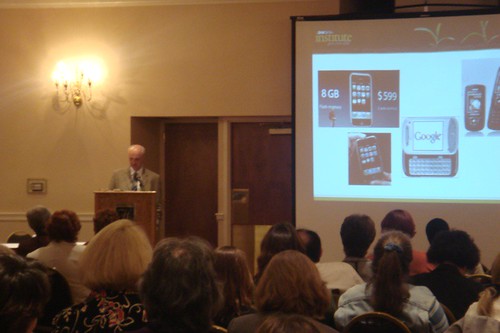
The bottom line: learn to adapt! Here, Stephen shows smart phones from Apple and Google that are microcomputers with text, audio, video, camera and websurfing capabilities - devices that allow our users to bring data and stories to them, wherever they are.
Links to many of the tools and websites Stephen referred to in his Technoschism keynote address are bookmarked on del.icio.us:
http://del.icio.us/informationgoddess29/stephenabram
I'm also tagging conference links under "masslib07"
Want to start implementing the 2.0 things he shared? Go to Learning 2.0 and complete the 23 things course in just 15-20 minutes a day!
Technoschism - Stephen Abram
Stephen starts: Google serves many more people that all librarians around the world. But can Google understand the excitement of a child during story hour? Google cannot replace librarians (even as hard as they try). Do we let these search engines control how we serve our community?
Some New Technologies
e-paper
light keyboards
projector the size of sugar cube- project computer screen on wall
i reader from Sony
e-book reader for $99 with reflected light
cell phones - Google phone and i-phone
Go XML - dominant personal devices - website needs to be seen on small screen too
Community - Are we misaligned with the end users?
Stephen offered a story-
Many children's librarians love their children but are not so sure about their mothers. They drop off their children and rush out of the children's room. Librarians are assuming that they are running out to smoke. But do we really know what they are doing? Maybe they are single parents trying to improve their lives? Maybe they are running upstairs to do research for a college paper that they are working on? The moral here is not to assume anything about your patrons. But to be prepared to meet you patrons where ever they need you to. In one library the librarians held a research class during story hour and had great attendance for both.
Paths on website - do we design our paths for our end users? Use graphics instead of words
"You can't make it too simple"
Understand and follow- JSR168 portlet and RSS - by doing this you ensure that your website fits on portable devices.
Google -250 million books - may soon rent books for nominal fees (This should scare librarians!)
"Get our heads out of the book"
Publishing and purchasing of books is up. Reading is up. We need to worry about our roles as librarians and not just defend the paper books.
How should we find our information? Google offers sponsor pages and are not concerned with our questions. Librarians are specialists and will be able to give information without it being skewed by sponsors. How do we let our patrons know that their searches are skewed?
Google Local - free wireless (entire cities & towns), find local businesses, find the best price of an item when walking through a mall.
However, when books are searched...no libraries appear!
Google is reaching out to students but not professors or librarians.
These big companies are trying to overtake our place in our communities. How are we going to handle this? How do we create an environment...how do we meet our user's needs?
"Libraries are about sharing' - social networking is also about sharing...let's make these connections.
What happens when DVD's die (or any other library inventory)? We need to be prepared for streaming...
Library 2.0 - be ready!
Get social-
Myspace - get involved! Bee where your patrons are!
Facebook - 95% of college students at U of Toronto have one.
Patrons can manage all your social groups through these networking sites. For life!
Second Life - a library here might receive 5000 visitors an evening.
Reorganize - virtual users are much different that physical patrons. Are we meeting their needs? We need to reach our future voters. IM-ing is how this new generation communicates.
Play - reinvigorate how we play. Set aside 15 minutes a day to play with these new sites. This gradual learning will introduce new technology in an non-frightening manner. Have your librarians take a library 2.0 class.
Increase your capacity to adapt!
I have to say this speech was very entertaining and very quick moving. This may not come across in this blog because sometimes I was so busy listening that it was hard to go back and describe what exactly had been said.
So to summarize: as librarians we must change, get to know the new technologies, meet our patrons where they are, we cannot sit back and just expect the patrons to come to us. There are many exciting directions that libraries are moving in...Let's Go!
Out Front With Stephen Abram: A Guide for Information Leaders - is Stephen's book if this blog sounded interesting to you.
Some New Technologies
e-paper
light keyboards
projector the size of sugar cube- project computer screen on wall
i reader from Sony
e-book reader for $99 with reflected light
cell phones - Google phone and i-phone
Go XML - dominant personal devices - website needs to be seen on small screen too
Community - Are we misaligned with the end users?
Stephen offered a story-
Many children's librarians love their children but are not so sure about their mothers. They drop off their children and rush out of the children's room. Librarians are assuming that they are running out to smoke. But do we really know what they are doing? Maybe they are single parents trying to improve their lives? Maybe they are running upstairs to do research for a college paper that they are working on? The moral here is not to assume anything about your patrons. But to be prepared to meet you patrons where ever they need you to. In one library the librarians held a research class during story hour and had great attendance for both.
Paths on website - do we design our paths for our end users? Use graphics instead of words
"You can't make it too simple"
Understand and follow- JSR168 portlet and RSS - by doing this you ensure that your website fits on portable devices.
Google -250 million books - may soon rent books for nominal fees (This should scare librarians!)
"Get our heads out of the book"
Publishing and purchasing of books is up. Reading is up. We need to worry about our roles as librarians and not just defend the paper books.
How should we find our information? Google offers sponsor pages and are not concerned with our questions. Librarians are specialists and will be able to give information without it being skewed by sponsors. How do we let our patrons know that their searches are skewed?
Google Local - free wireless (entire cities & towns), find local businesses, find the best price of an item when walking through a mall.
However, when books are searched...no libraries appear!
Google is reaching out to students but not professors or librarians.
These big companies are trying to overtake our place in our communities. How are we going to handle this? How do we create an environment...how do we meet our user's needs?
"Libraries are about sharing' - social networking is also about sharing...let's make these connections.
What happens when DVD's die (or any other library inventory)? We need to be prepared for streaming...
Library 2.0 - be ready!
Get social-
Myspace - get involved! Bee where your patrons are!
Facebook - 95% of college students at U of Toronto have one.
Patrons can manage all your social groups through these networking sites. For life!
Second Life - a library here might receive 5000 visitors an evening.
Reorganize - virtual users are much different that physical patrons. Are we meeting their needs? We need to reach our future voters. IM-ing is how this new generation communicates.
Play - reinvigorate how we play. Set aside 15 minutes a day to play with these new sites. This gradual learning will introduce new technology in an non-frightening manner. Have your librarians take a library 2.0 class.
Increase your capacity to adapt!
I have to say this speech was very entertaining and very quick moving. This may not come across in this blog because sometimes I was so busy listening that it was hard to go back and describe what exactly had been said.
So to summarize: as librarians we must change, get to know the new technologies, meet our patrons where they are, we cannot sit back and just expect the patrons to come to us. There are many exciting directions that libraries are moving in...Let's Go!
Out Front With Stephen Abram: A Guide for Information Leaders - is Stephen's book if this blog sounded interesting to you.
Technoschism: Stephen Abram
Technoschism: Reorganizing and Restructuring Libraries for the Real Future
Stephen Abram, Sirsi-Dynix
Slow change? My eye.
[While the technology rebooted, we discussed Google and how search engine optimizers manipulate the hits you get. News to me, which is sad. Must learn more about this.]
Library core skills is not information - libraries improve the quality of the question and the experience
Information Ocean, not highway. Exploration space, not a collection space.
We must be about more than the books, we must be about the entire experience.
"We librarians have to learn when we study something to death, Death was not the original goal!"
We can't teach people to flush....how are we going to teach them Boolean logic?
Stephen really serves Google, but only in the way of enlightening us. If half of what he says is true, Google knows all.]
Get your texthead to nexthead: What is your strategy for dealing with the death of DVDs, CDs, cassettes, etc.?
Types of learners: experience learners, visual learners, audio learners, text learners. How do we support the full range of learning, of learning styles?
Brains have changed in millenials (3rd shift in brain mapping). We need to shift our ways of providing services to match their brains.
SchoolRooms -- built based on reports on how millenials think. User-centered design.
Are you ready for Imagineering the Library? Are we ready to be the purple cow?
It's the staff that distinguishes us from the search engines? People live in the foothills of the information ocean, and libraries can be there.
Change for our users in the context of learning and community.
[Wow, Stephen Abram is wonderful. I'm glad I've finally gotten the chance to see him speak.]
Stephen Abram, Sirsi-Dynix
Slow change? My eye.
[While the technology rebooted, we discussed Google and how search engine optimizers manipulate the hits you get. News to me, which is sad. Must learn more about this.]
Library core skills is not information - libraries improve the quality of the question and the experience
Information Ocean, not highway. Exploration space, not a collection space.
We must be about more than the books, we must be about the entire experience.
"We librarians have to learn when we study something to death, Death was not the original goal!"
- Epaper & eReaders withfullsize screens
- Light-based keyboards & fullsize monitors
- Projectors the size of sugar cubes
- June 2007 - every cable and phone wire will have switched over to broadband
- iReader
- iPhone & other full-service phones (G3 standard)M/li> Web on a credit card
- Everything is getting smaller - we need to get there in the first wave
We can't teach people to flush....how are we going to teach them Boolean logic?
- Advice #1: Go XML for Dominant Personal Services -- XML senses the device and changes to fit
- All that matters is: Community, Learning, Interaction -- he collected stories to create personas and there was no overlap between the stories the librarians told about what was important and what the users said was important
- Intention Paths -- is your library website a closed Swiss Army knife? Make sure that your website information such that it works
- You can't make it too simple
- Advice #2: Understand JSR168, Portlets and RSS
- 250 million books go online in the next five years -- what then? A chapter and paragraph-level economy on books, and how do we integrate ourselves into that?
- Get our heads out of the book -- books aren't at risk, librarians are at risk
- Get realistic about the role of reading in electronic environments
Stephen really serves Google, but only in the way of enlightening us. If half of what he says is true, Google knows all.]
- Advice #3: Geton the OpenURL and FedSearch Wagon -- give yourself and your users search options that don't harvest your information in the process of helping you search
- Let Google do the Who, What, Where, When questions. Librarians can focus on the How and Why questions. Let librarians focus on their specialties and expertises and promote themselves, let them become experts.
- What librarians do best is context management, not content management
- Advice #4: GPS & Broadband: Deal With It, Act Local?
- Google knows where your users are and can tailor their services to the local level.
- Advice #5: Be ready for advanced social networks
- Are you ready for Web 2.0/Library 2.0?
- Libraries are about communities and environments, not single-functions like the social software
- We need to create environments and provide information that delight our users
- We need to have a discussion about this, not about making OPAC suck less
- Use del.icio.us and wikis to share and preserve the knowledge of reference libriarans
Get your texthead to nexthead: What is your strategy for dealing with the death of DVDs, CDs, cassettes, etc.?
Types of learners: experience learners, visual learners, audio learners, text learners. How do we support the full range of learning, of learning styles?
- Advice #6: Get social
- BiblioCommons -- Canada's answer to all of this.
- We have an entire generation socially networking for life. We need to be out there -- facebook.com seems to be one of the strongest contenders.
- Ning.com has a Library 2.0 group.
- ActiveWorlds and SecondLife virtual worlds getting thousands of questions a night, -- there is a huge library presence: teaching, answering questions, book discussions.....everything that we do in Real Life we do there.
- Magazine Content, News Content...it's all becoming social. How do we insert ourselves into the social content map?
- Advice #7: Get political
- Become an advocate in all the places that we are being social
- These millenials will be voting on our bond issues in the next ten years, we NEED them
- Advice #8: Reorganize
- E-learning
- Information Commons
- Learning Commons
- Community Integration
- Reference Cowboys
- Virutal Operations and Branches -- your virtual visitors are completely different than your in-person visitors
- Advice #9: Get Conversational
- Instant Messaging reference *works* -- Thomas Ford Memorial Library gets 50% of their total reference through IM
- Cha-Cha
- IM is better than email for reference
- Advice #10: Increase our HR ability to adapt
- Everything is a toy...play with them -- we learn through play
- Use the PLCMC Lerarning 2.0 model as a structure to play in
- "information literacy" courses are like "ugly salons"
- Use the same list as a checklist of things you can do
- The culture of the library changes as this happens
- Build a petting zoo in the library so that the public can learn to play on these technologies
Brains have changed in millenials (3rd shift in brain mapping). We need to shift our ways of providing services to match their brains.
SchoolRooms -- built based on reports on how millenials think. User-centered design.
Are you ready for Imagineering the Library? Are we ready to be the purple cow?
It's the staff that distinguishes us from the search engines? People live in the foothills of the information ocean, and libraries can be there.
Change for our users in the context of learning and community.
[Wow, Stephen Abram is wonderful. I'm glad I've finally gotten the chance to see him speak.]
Inspiration from Callie!

That’s right librarians – Callie is telling us to get fired up and tell our story and be proud of our profession – Be loud and proud! I love the message!!
“Speak up for libraries” is part of her message – If we don’t, no one else will
“Act now” “Success will not wait” “This is the time, this is the place, I am the person, tell the stories, save the libraries”
Right on Callie!!
Callie Crossley
The first keynote speaker this morning is Callie Crossley. Other bloggers will tell you more about her keynote, but I want to mention that she directed two episodes of the series Eyes on the Prize, now available on DVD. Everyone should know about this series! Ms. Crossley's two episodes are "Bridge to Freedom: 1965" and "No Easy Walk: 1961-1963."
Subscribe to:
Posts (Atom)
